Meta Advantage+ vs manual campaigns for local leads
Advantage+ or manual Meta leads campaigns for a local business: the 50-a-week learning threshold, CRM signals, location settings and ad categories.
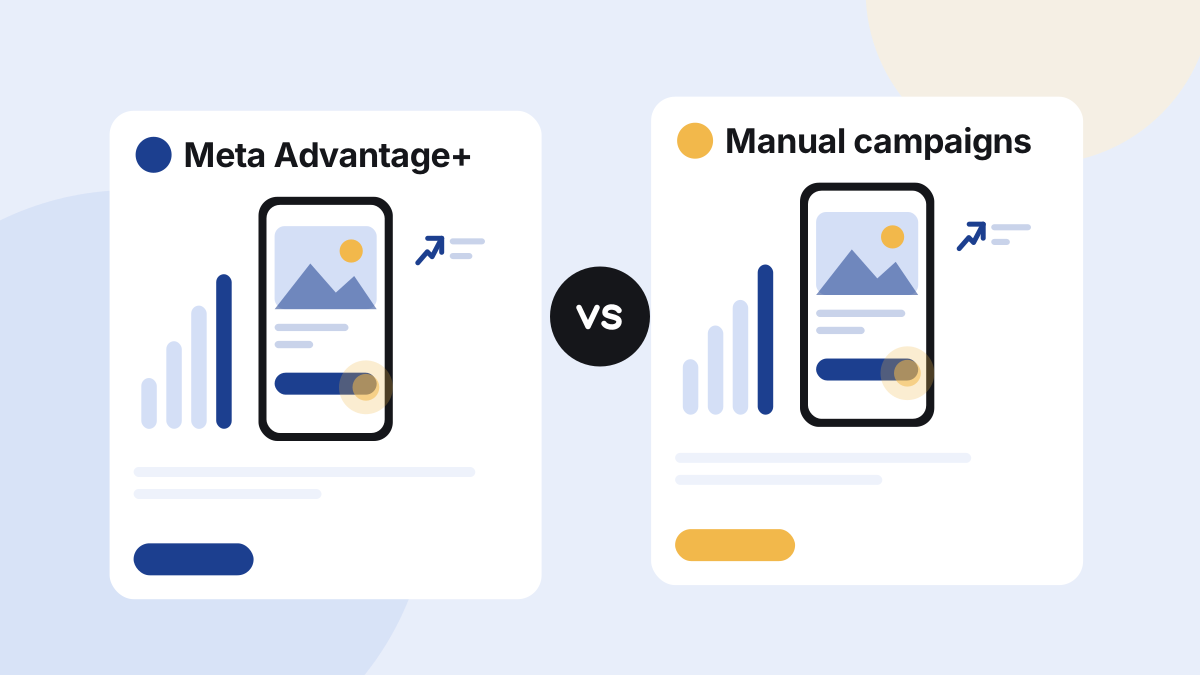
Open Ads Manager, pick the Leads objective, and in most accounts Meta has already made three decisions for you. The budget sits at the campaign level, the audience is Meta’s to find, and the ads can run in every placement. That bundle is an Advantage+ leads campaign. Narrow any of the three far enough and a small label flips to “Advantage+ off”: a manual leads campaign.
The flip usually happens by accident, when someone gives each ad set its own budget or drops one placement while fixing something else. It matters, because the two setups learn differently.
The 60-second version
- Advantage+ leads is Meta's default: one campaign budget, Meta's audience, every placement. Narrow any of the three too far and it becomes a manual campaign.
- Both need volume. An ad set is learning limited when it is unlikely to get about 50 optimization events a week, and below that, fewer ad sets matter more than the label.
- Send "booked", "showed" and "paid" back from your CRM, or either setup hunts for people who like filling in forms.
- Check the special ad category and the "reach more people" location box before anything else.
Four questions that settle it
- How many leads a week does this campaign produce? An ad set becomes “learning limited” when it is unlikely to get about 50 optimization events in the week after the last significant edit. Under that, run one campaign with one ad set, and the label matters less than keeping the budget in one place.
- Does Meta ever hear which leads became customers? If your CRM sends back “booked”, “showed” and “paid”, Advantage+ has the signal it is built for. If Meta only sees form fills, fix that first, because neither setup can find customers it never hears about.
- How tight is the area you serve? Location is a hard control in both setups, so a one-county business does not need a manual campaign to stay on the map. It does need the “reach more people” box unchecked.
- Does your ad fall into a special ad category? Housing, employment and financial products and services remove ZIP codes and fix age and gender in either setup, so manual buys you little there.
Advantage+ leads, in plain words
Meta applies Advantage+ campaign budget, audience and placements by default. The system picks who sees the ads from signals such as past conversions and pixel data, and moves budget between ad sets. Lead formats do not change: instant forms, website forms, calls and click-to-message all stay available.
You are not handing over everything. Location, minimum age, excluded custom audiences and languages stay hard controls, so current customers can be kept out. Age, gender and interests become suggestions: suggest women, and the ads “could also deliver to men” if the system finds them likely to respond.
Location needs one more look. Meta won’t target beyond your locations unless “reach more people likely to respond to your ads” is checked, and when you pick a city or region, that box may already be checked by default. It then adds people interested in traveling to or buying in the area. A business that serves a fixed area should uncheck it, and it is the first setting we would look at in a local account.
A manual campaign, in plain words
In a manual campaign you can set a budget per ad set, choose placements, and make location, age and gender hard limits. Detailed targeting is softer than it looks: the system can reach “a broader group of people than you defined” when it expects better results.
What manual gives you is control, not a clean experiment. Ad sets in one campaign can reach the same people, and Meta warns that informal tests lead to overlapping audiences. To compare two audiences or offers fairly, use Meta’s A/B test, which splits the audience evenly.
Retargeting is manual’s clearest job, since Meta says Advantage+ audience “isn’t recommended” for it. The price is fragmentation. Five ad sets splitting a small budget are five ad sets short of 50 weekly events, and the fix for learning limited runs the other way: combine ad sets and widen the audience.
The fine print on Meta’s numbers
Meta says that in early testing, leads campaigns with Advantage+ on averaged 14% lower cost per lead and 10% lower cost per qualified lead than campaigns with it off, across 19 tests from November 2024 to January 2025.
Read the confidence levels: more than 95% for the cost per lead result, 83% for cost per qualified lead. The evidence for cheaper leads is stronger than the evidence for cheaper good leads, and for a local business the second number is the one that pays the rent.
One more change matters. From April 2026 the qualified leads goal (some Meta pages still call it conversion leads) needs a Conversions API integration for new campaigns, and existing campaigns are affected from August 2026, whichever setup you pick.
Side by side
| Advantage+ leads campaign | Manual campaign | |
|---|---|---|
| Suits | Steady weekly lead volume, with outcomes flowing back from a CRM | Low volume, retargeting, or ads that need hard audience limits |
| Control you keep | Location, minimum age, excluded audiences and languages; age, gender and interests are suggestions | Location, age, gender and placements; detailed targeting may still widen |
| Budgets | One campaign budget that Meta moves between ad sets | Budgets can be fixed per ad set |
| Testing | Ad sets are not a controlled test | Ad sets are not one either; use Meta’s A/B test |
| Ask the person running it | “Which stages does our CRM send back, and how many qualified leads did Meta see last week?” | “How many optimization events does each ad set get a week, and why is it split this way?” |

Pros and cons
Advantage+ leads campaign
Pros
- Fewer settings for a single-location owner to get wrong.
- Budget moves to whatever is producing, without daily checks.
Cons
- Age, gender and interests are no longer guaranteed limits.
- Excluding a placement in any ad set, or giving ad sets their own budgets, turns it off.
Manual campaign
Pros
- Location, age, gender and placement limits are real limits.
- The right tool for retargeting a known list.
Cons
- Easy to split a small budget into ad sets that never leave learning.
- Narrow targeting can push costs up in a small area.
One workaround: account-level controls do not trigger Advantage+ off, so some placements (Audience Network, Marketplace and the right column) can be excluded once for the whole account, where that setting has rolled out. Those controls do not cover special ad category ads.
Three businesses, three answers
A med spa with steady volume: Advantage+, with CRM stages flowing back.
Consult offers across a metro are close to the case Advantage+ was built for. The work is in Events Manager: Meta may put a health or wellness business’s dataset in a category that restricts “specific mid and lower funnel events,” and custom events stay blocked until you review and confirm them.
Name the stages plainly, “booked”, “showed” and “paid”. Event names must not imply prohibited information, which includes medical procedures and treatments, so a stage named after a treatment needs renaming. Meta’s guidance puts good signal for the qualified leads goal at more than 250 leads a month, so a smaller med spa stays on the leads goal while the stages build up. Our med spa page covers the rest.
A roofer in one county: one campaign, one ad set, either setup, until financing enters the ad.
One county rarely produces 50 leads a week. Meta has no county option, so the location control is the county’s ZIP codes, or cities or a pin with a radius that covers it, with “reach more people” unchecked.
Then check the offer. Meta’s examples for the financial products and services category include “in-house installment payments,” so an ad built around roof financing may need that category. Once it applies, both setups are locked the same way:
- no ZIP codes or location exclusions, and a city or pin expands to a radius (15 miles in Meta’s example), so the county can only be approximated
- ages generally fixed at 18 through 65+, all genders, no lookalike audiences
Have whoever runs it confirm the category before launch, since ads may be rejected without it. The roofing page shows where Meta sits among a roofer’s lead sources.
A new clinic with no history: the default Advantage+ setup, one ad set.
With no history, manual detailed targeting would be a guess too. Take the default with one ad set, the service area as the location, “reach more people” unchecked, and the leads goal until there is volume. The real work is the pixel, the Conversions API and the dataset’s category. Before any of it is installed, a clinic covered by HIPAA should have counsel confirm what may be sent to an ad platform. This is not legal advice.
Where we come in
We run Meta ads for local businesses, and most of the work sits behind the ads: mapping your CRM stages to events Meta will accept, checking the dataset’s category before anything is sent, and keeping stage names clear of anything Meta treats as prohibited. The CRM is often a GoHighLevel build. The ad account stays in your name and we work in it with the access you give us, so what the campaign has learned stays with your business.
Before you choose
Count last month’s leads, count how many became customers, and find out whether Meta ever saw the second number. For your free plan, we would check how many optimization events each ad set got last week, whether the location box reaches past your area, whether the dataset or the offer falls in a restricted category, and which stages your CRM can send back. Then we would tell you which setup your volume supports today, and what has to change before the other is worth trying.

You made it to the end. Now let's get you more customers.
Meta Ads is part of what we set up and run every day, along with the search, ads and follow-up around it. Tell us about your business and we will send back what to fix first.
- A free consult. A real conversation about your business, your area and what is not working yet.
- An honest evaluation. Where you stand in search, ads and follow-up next to the businesses you lose customers to.
- A plan you keep. What we would fix first and why. It is yours whether or not you work with us.
Form not loading? Email hello@beyaoshy.com and we will reply within one business day.