How to open a med spa
This guide takes a med spa from its ownership structure to its first booked patients: who may own it, who may examine and inject, what the FDA requires of the product, and the rules in California, Texas, Florida and New York. The most useful finding is that a med spa is legally a medical practice, and in California a doctor who serves as medical director of a lay-owned spa is "aiding and abetting the unlicensed practice of medicine," so the structure has to be settled before the lease is signed.
- Med spa license
- None by that name in California, Texas, Florida or New York; the rules sit in medical practice law
- The good faith exam
- An MD, DO, NP or PA, per AmSpa; an RN who does it risks criminal prosecution
- California ownership
- Lay owners may not own any part of a medical practice, says the Medical Board
- Texas laser hair removal
- A $900 TDLR facility license unless the facility is physician-owned
- Industry size, 2023
- 10,488 med spas averaging $1,398,833 in revenue (AmSpa)
- Local Services Ads
- No med spa or injector category in Google's list
What a med spa is in law, and the ways to own one
The American Med Spa Association defines a medical spa as “a hybrid between an aesthetic medical center and a day spa,” combining non-surgical aesthetic medical services, “on-site supervision by a licensed health care professional,” trained practitioners and a relaxing setting (AmSpa FAQ). The spa half is the decor; the legal half is medicine. The Medical Board of California: “The use of prescriptive drugs and devices, however, is the practice of medicine, and the same laws and regulations apply to these types of treatments as those driven by medical necessity” (Medical Board of California). Every choice below, from whose name is on the lease to who holds the syringe, follows from that sentence.
Four ownership models:
- Physician-owned. AmSpa: “Physicians can own medical practices throughout the country. After that, things get complicated” (AmSpa, how to open a med spa).
- Led by a nurse practitioner. Asked about an NP running a spa with no doctor, AmSpa answers: “It depends on your state, but as a general rule, yes, that’s perfectly fine.”
- A lay founder with a management company. AmSpa: “A Management Services Organization (MSO) offers a legal pathway for non-physicians.” Usually that means a physician-owned entity doing the clinical work and the founder’s company supplying space, staff and marketing under contract. Whether that is lawful depends on the state.
- Mobile and event work. Most boards do not require injections at the doctor’s office, AmSpa says, but “all the requirements of medical treatments still apply, even though the treatment is being done offsite.”
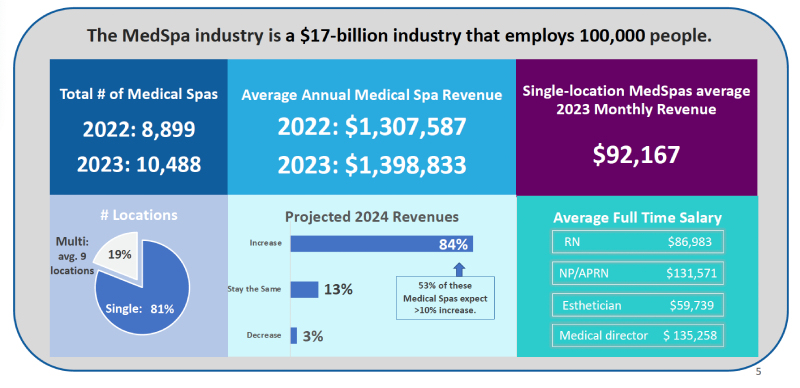
AmSpa’s 2024 industry summary counted 8,899 med spas in 2022 and 10,488 in 2023. Average revenue in 2023 was $1,398,833, a single-location spa averaged $92,167 a month, 81% of spas had one site, and the industry is put at $17 billion with 100,000 employees (AmSpa 2024 industry summary). Start-up costs appear only in the $995 full report (AmSpa statistics), so this guide quotes none.
The outlook: the people you will compete to hire
BLS figures published through O*NET describe the clinical labor pool:
| Occupation | Employed, 2024 | Median pay, 2025 | Projected growth, 2024 to 2034 | Openings, 2024 to 2034 |
|---|---|---|---|---|
| Nurse practitioners | 320,400 | $132,300 | Much faster than average (7% or higher) | 29,500 |
| Registered nurses | 3,391,000 | $97,550 | Faster than average (5% to 6%) | 189,100 |
| Skincare specialists | 97,400 | $45,330 | Much faster than average (7% or higher) | 14,500 |
Inside med spas, AmSpa’s 2023 figures put average full-time pay at $131,571 for NPs and APRNs, $86,983 for RNs, $59,739 for estheticians and $135,258 for medical directors (AmSpa 2024 industry summary). An injector with a following is the hire every new spa in a city is chasing.
Weight-loss drugs are a pharmacy question before they are a service line: the FDA says “Compounded drugs should only be used in patients whose medical needs cannot be met by an FDA-approved drug” (FDA on unapproved GLP-1 drugs).
Licensing: who may own, examine and treat
Rules that apply everywhere
No federal agency licenses med spas, and none of the four states below issues a license by that name.
The good faith exam. AmSpa: “Whether it’s called the Good Faith Exam, the initial exam, or the initial patient consultation, seeing a patient and deciding on a treatment plan is defined as the practice of medicine. Only an MD, DO, NP, or PA can legally perform these assessments.” And: “Important: An RN cannot administer the Good Faith Exam without running the risk of criminal prosecution for the unauthorized practice of medicine” (AmSpa, how to open a med spa).
Who treats. AmSpa’s general rule is that “anything with needles or a scalpel should be performed by a practitioner who is, at a minimum, a registered nurse under the supervision of a physician,” and “most states consider all laser treatments, including laser hair removal, to be medical treatments” (AmSpa FAQ).
Product. In its 2024 counterfeit Botox alert, the FDA reminded providers that “Federal law requires that all health care providers who dispense or administer prescription drugs purchase those products only from authorized sources” (FDA counterfeit Botox alert). That November a Massachusetts spa owner who “is an aesthetician and is not licensed nor certified to dispense or administer prescription drugs or devices” was arrested over about 1,631 Botox and 1,085 filler appointments allegedly using counterfeit product (FDA and DOJ release). Dermal fillers are “medical device implants approved by the FDA” for “adults 22 years of age or older” (FDA on dermal fillers), and a prescription laser is sold “only to or on the prescription or other order of such practitioner” (21 CFR 801.109), so a founder without a license cannot simply buy one for staff to run.
This guide quotes ownership and exam rules as the sources state them. It is not legal advice: have the structure reviewed by a health care attorney in your state before you sign a lease or a management agreement.
Four states side by side
| State | Agency | License | Key requirements, as the agency states them |
|---|---|---|---|
| California | Medical Board of California | No med spa license. A medical corporation, majority physician-owned | “Laypersons or lay entities may not own any part of a medical practice.” The prior exam “may not be delegated to registered nurses” |
| Texas | Texas Medical Board; TDLR for laser hair removal | No med spa license. A TDLR laser hair removal facility license unless physician-owned | Since January 9, 2025: a practitioner-patient relationship first, a person trained in basic life support on site, the delegating physician’s name and license number posted |
| Florida | Board of Medicine; Agency for Health Care Administration for clinics | No med spa license. A health care clinic license unless the practitioner-owned exemption fits | Exempt if “wholly owned by one or more licensed health care practitioners” with an owner supervising. Laser hair removal by trained electrologists under a physician |
| New York | State Education Department, Office of the Professions | No med spa license. A professional service corporation owned by licensees of one profession | “Business corporations cannot hire a licensee to provide professional services.” Percentage-based fees count as fee splitting. RNs need a patient-specific order |
California: lay ownership is barred
Business and Professions Code 2400: “Corporations and other artificial legal entities shall have no professional rights, privileges, or powers” (California BPC 2400). The Medical Board applies it to spas: “Laypersons or lay entities may not own any part of a medical practice,” and “The majority of stock in a medical corporation must be owned by California licensed physicians, with no more than 49% owned by other licensed health care professionals,” a ceiling that Corporations Code 13401.5 confirms, with registered nurses and physician assistants among the permitted minority shareholders.
The hired medical director is closed off: “A physician who acts as medical director of a lay-owned business is aiding and abetting the unlicensed practice of medicine.” So is a management company with clinical control: “businesses that control medical records, the hiring and firing of healthcare staff, decisions over coding and billing, and the approving or selection of medical equipment or drugs, violate the law.” A nurse practitioner may do the prior exam “if acting under standardized procedures,” and the location must be an “organized healthcare system,” not a salon (Medical Board of California).
That board document is undated and older. Its ownership rules match the statutes above, but California’s newer NP and PA rules were not verified here: confirm them with a California health care attorney.
Texas: delegation rules and a separate laser license
Since January 9, 2025, 22 TAC 169.25 treats cosmetic injections and “the use of a prescription medical device for cosmetic purposes” as the practice of medicine that may be “properly delegated and supervised.” Before a delegated act, the physician, or a PA or APRN under delegation, must “establish a practitioner-patient relationship,” have “at least one person trained in basic life support” present, and “be onsite during the procedure” or “be immediately available for emergency consultation” (22 TAC 169.26). Each public area and treatment room posts “the name(s) of the delegating physician(s) including their Texas medical license number,” and every provider wears a name tag showing credentials (22 TAC 169.28).
The Texas Department of Licensing and Regulation (TDLR): “Anyone in Texas practicing laser hair removal … must be licensed,” except in hospitals, hospital-owned clinics and “a facility owned or operated by a physician for the practice of medicine” (TDLR laser hair removal). Any other facility needs “a written contract with a consulting physician” practicing within 75 miles, a Laser Safety Officer and an LHR Professional, and “An Advanced Nurse Practitioner may not serve in the capacity of the consulting or designated physicians.” The facility fee is $900 as of October 2026 (TDLR, Laser Hair Removal at a Glance).
Elective IV therapy, the kind “sought by the patient to alleviate symptoms of temporary discomfort or improve temporary wellness,” falls under HB 3749 outside a physician’s office or licensed facility, effective September 1, 2025: prescribing may be delegated to a PA or APRN, and administering to a PA, APRN or “a registered nurse acting under adequate physician supervision” (Texas HB 3749).
Texas rules on who may own a medical practice were not verified for this guide. Confirm the structure with a Texas health care attorney.
Florida: the clinic license question
The Health Care Clinic Act covers “an entity where health care services are provided to individuals and which tenders charges for reimbursement for such services,” and exempts one “wholly owned by one or more licensed health care practitioners” when a practitioner owner “is supervising the business activities” (Florida Statutes 400.9905). A spa outside that exemption should put the clinic license question to the Agency for Health Care Administration before opening. Electrologists may run laser hair removal only with specified training, “under the direct supervision and responsibility of a physician properly trained in hair removal,” on the premises or by telehealth within 150 miles, with protocols filed with the Department of Health (Florida rule 64B8-56.002).
New York: fee splitting and the patient-specific order
NYSED: “it is clear that business corporations cannot hire a licensee to provide professional services,” and in a professional service corporation “all shareholders must be licensees of one profession” (NYSED, corporate practice). Education Law 6530 makes it misconduct to permit “any person to share in the fees for professional services,” including “any arrangement or agreement whereby the amount received in payment for furnishing space, facilities, equipment or personnel services used by a licensee constitutes a percentage of, or is otherwise dependent upon, the income or receipts of the licensee” (NYSED, Article 131-A). A management fee set as a share of revenue matches that wording on its face. RNs carry out regimens “ordered for a specific patient by a physician or other qualified health care practitioner who has examined the patient,” and the standing-order exceptions NYSED lists do not include cosmetic procedures (NYSED, non-patient-specific orders).
Setting up the business
Entity and EIN. The SBA’s guide to business structures is a starting point only. A med spa’s clinical entity is often a professional corporation, and a founder’s management company is a second entity with its own EIN, free from the IRS.
Insurance. Florida physicians show financial responsibility “as a condition of licensing,” one route being “professional liability coverage in an amount not less than $100,000 per claim, with a minimum annual aggregate of not less than $300,000” (Florida Statutes 458.320), and APRNs must “maintain medical malpractice insurance or provide proof of financial responsibility” (Florida Statutes 456.048). Beyond state minimums, the package we usually see covers malpractice for each provider and the entity, general liability, property, cyber, and product liability for retail skincare.
Workers’ compensation. California requires it “even if they have only one employee” (California CSLB). In Texas it “is not required in most cases” (Texas Department of Insurance). Outside construction, Florida covers employers with “four or more employees” (Florida Statutes 440.02), and “Virtually all employers in New York State must provide workers’ compensation coverage” (New York Workers’ Compensation Board).
Privacy. HIPAA reaches a provider that “transmits any health information in electronic form in connection with a transaction covered by this subchapter” (45 CFR 160.103), so a cash-only spa may sit outside it. Texas reaches anyone who “comes into possession of protected health information” (Texas Health and Safety Code 181.001), and since September 1, 2025, HB 4224 requires posting on the website and at the facility how to request records, contact the licensing authority and file a complaint (Texas HB 4224).
Sales tax and the city. Retail skincare is usually taxable and medical services usually are not, but each state draws that line. Expect a local business license, a certificate of occupancy for medical use and a sharps and biohazard waste contract.
Rooms, devices, product and paperwork
The build-out we see in nearly every spa: treatment rooms with sinks, a clean drug storage area, a locked medication refrigerator and sharps containers. In every spa we have seen, toxin and filler accounts sit in the medical practice’s name, with a licensed prescriber, opened directly with the manufacturer or an authorized distributor. Most spas we work with lease or finance their lasers, and a Texas facility that is not physician-owned needs its consulting-physician contract and Laser Safety Officer before the first treatment.
AmSpa’s partner form packages advertise “24 Treatment SOPs,” “19 Consent Forms,” “11 Intake Forms” and “11 OSHA Forms,” among others (AmSpa, how to open a med spa), a fair measure of the paperwork a compliant spa keeps. Software usually means an EHR with photo charting and signed consents, online booking, and a point of sale that handles packages and memberships.
Pricing and the numbers that matter
Pricing units in the spas we work with: neuromodulators by the unit or area, filler by the syringe, laser and body contouring by the session or package, and memberships with monthly credits. AmSpa’s recommended metrics start with “Net profit per treatment” and “Revenue per hour (per room and/or per provider),” and it warns that “Getting a lot of patients in the door doesn’t necessarily mean you will end the day with more money than you started with” (AmSpa, how to open a med spa).
Commissions and promotions are legal questions: AmSpa lists provider commissions and “discounts, referral programs, or Groupon deals” among the answers that vary by state (AmSpa med spa laws), and California’s board says “The use of ‘for as low as’ in advertising procedures, is strictly prohibited” (Medical Board of California). SBA 7(a) loans, up to $5 million, can fund working capital, equipment and “Changes of ownership (complete or partial)” if you buy an existing spa (SBA 7(a) loans). In our experience laser hair removal and resurfacing sell in fall and winter, and injectables climb before the holidays and wedding season.
Hiring and safety
The supervision rules write the org chart. Exams go to an MD, DO, NP or PA. Injections go, at minimum, to an RN under supervision, and AmSpa says “an aesthetician should not be performing Botox injections” (AmSpa FAQ). Lasers go to RNs, NPs or PAs in California, to trained electrologists under physician supervision in Florida, and in a Texas facility that is not physician-owned, to TDLR licensees who completed a 40-hour course and “a criminal history background check” (TDLR, Laser Hair Removal at a Glance). No state here accepts a weekend injector course in place of a license.
OSHA’s bloodborne pathogens standard requires “a written Exposure Control Plan” and the hepatitis B vaccine offered “to all employees who have occupational exposure” (29 CFR 1910.1030), which covers injectors, IV staff and anyone handling sharps. In Texas, someone trained in basic life support stays on site for every delegated procedure.
Finding the first patients
Google Business Profile. A med spa is a storefront: Google wants “a precise, accurate address,” and a “virtual office … isn’t eligible for a Business Profile” (Google Business Profile guidelines). Verify the profile as soon as the lease is signed and list each provider with credentials; our Google Business Profile work covers the setup.
No Local Services Ads shortcut. Google’s list has categories for dermatologists and plastic surgeons but none for a med spa or injector, and “The Google Verified badge is currently unavailable for verticals in the auto, beauty, and dining categories,” where hair removal sits (Google Local Services Ads). Local Services Ads are also moving into Google Ads as “Performance Max campaigns with pay-per-lead goals” (Google Ads Help).
Search ads. In the US you may use prescription drug terms in ad text and landing pages, but “you must be certified in order to keyword-target these terms” (Google restricted drug terms). Brand-name toxins are prescription drugs, so new spas build Google Ads keywords on treatment words such as “lip filler” and “wrinkle relaxer.”
Meta. Since its July 23, 2026 update, Meta’s Health and Wellness policy allows cosmetic procedure ads “depicting before and after transformation” when they are “targeted to people at least 18 years or older,” and still bans “statements of inferiority about physical appearance” (Meta Health and Wellness policy). State rules still govern the photo: California’s board prohibits undisclosed models and “touched-up or refined photos” (Medical Board of California), and the FTC expects health claims to rest on “competent and reliable scientific evidence” (FTC Health Products Compliance Guidance). Our Meta Ads page covers campaigns built inside those rules.
Reviews. In BrightLocal’s 2026 survey, generative AI use for local recommendations rose “from 6% last year to 45%” (BrightLocal Local Consumer Review Survey). The FTC’s 2024 rule bans fake reviews and lets the agency “seek civil penalties against knowing violators” (FTC fake reviews rule). Ask every patient after the visit; here is how a review routine runs.
The first appointments. In the launches we have seen, the first patients come from the lead injector’s existing clientele, an opening event with in-person good faith exams, and a membership for repeat neuromodulator patients. Check any referral reward or launch discount against the state questions above first. The med spa marketing playbook covers what comes next.
What trips up new owners
- A lay owner with a hired medical director. Prohibited in California. Settle the structure before the lease.
- An RN-only clinical team. Without an MD, DO, NP or PA, nobody can do the first exam.
- Toxin from outside authorized channels. A federal violation the FDA is actively pursuing.
- Missing the 2025 Texas changes. New delegation rules on January 9, then the IV therapy law and the HB 4224 posting rule on September 1.
- A retouched before-and-after. Meta may accept it in an adults-only ad; California’s board still prohibits it.
- Counting patients instead of revenue per hour. A full room of discounted treatments can lose money.
Questions founders ask about opening a med spa
Can I own a med spa if I am not a doctor?
It depends on the state, and in California the answer is no: “Laypersons or lay entities may not own any part of a medical practice.” New York bars business corporations from hiring licensees, and AmSpa calls an MSO “a legal pathway for non-physicians” where the state allows one. For Texas, ask a health care attorney.
Can a nurse practitioner open a med spa without a physician?
AmSpa’s answer is “as a general rule, yes,” depending on the state. Texas still routes IV prescribing through physician delegation and bars an advanced nurse practitioner from serving as a laser facility’s consulting physician. For California’s newer NP rules, ask a health care attorney.
Can a registered nurse do the good faith exam?
No: AmSpa says only an MD, DO, NP or PA can, and California’s board says the prior exam “may not be delegated to registered nurses.”
Does a doctor have to be on site?
Usually not, AmSpa says, though “there are often distance and documentation requirements.” Texas requires the physician, PA or APRN to be on site or immediately available, and Florida allows remote laser supervision only within 150 miles.
Do I need a license to offer laser hair removal?
In Texas, yes, from TDLR, unless the facility is physician-owned. Florida allows trained electrologists under physician supervision, and California limits delegated laser work to RNs, NPs and PAs.
Is a med spa covered by HIPAA?
Only if it transmits health information electronically in a covered transaction, though Texas privacy law covers a cash-only Texas spa either way.
How much does it cost to open a med spa?
We have no sourced figure: AmSpa’s start-up costs sit in its paid report. Build the budget from real quotes for the lease, the laser and the first providers’ pay.
Sources
Checked on October 3, 2026. Rules and fees change, and many are set state by state or city by city: confirm the current requirements with the agency that issues them before you apply.
- American Med Spa Association, frequently asked questions
- American Med Spa Association, how to open a med spa
- American Med Spa Association, med spa statistics (updated April 2026)
- American Med Spa Association, 2024 State of the Industry summary (2022 and 2023 data)
- American Med Spa Association, med spa laws and state legal questions
- Medical Board of California, The Bottom Line: The Business of Medicine, Medical Spas
- California Business and Professions Code 2400
- California Corporations Code 13401.5, permitted shareholders of a medical corporation
- 22 Texas Administrative Code 169.25, nonsurgical medical cosmetic procedures
- 22 Texas Administrative Code 169.26, requirements before a delegated procedure
- 22 Texas Administrative Code 169.28, posting and name tags
- Texas HB 3749, IV therapy (enrolled text, effective September 1, 2025)
- Texas Department of Licensing and Regulation, laser hair removal
- Texas Department of Licensing and Regulation, Laser Hair Removal at a Glance (December 2025)
- Texas Health and Safety Code 181.001, covered entity definition
- Texas HB 4224, posting requirements for covered entities (effective September 1, 2025)
- Florida Statutes 400.9905, Health Care Clinic Act definitions and exemptions
- Florida Administrative Code 64B8-56.002, laser and light hair removal by electrologists
- Florida Statutes 458.320, physician financial responsibility
- Florida Statutes 456.048, APRN malpractice insurance or financial responsibility
- Florida Statutes 440.02, workers' compensation definitions
- New York State Education Department, corporate practice of the professions
- New York State Education Department, Education Law Article 131-A
- New York State Education Department, non-patient-specific orders and protocols for RNs
- New York Workers' Compensation Board, coverage requirements
- FDA, counterfeit version of Botox found in multiple states (April 2024, updated May 2024)
- FDA and DOJ, spa owner arrested over alleged counterfeit injections (November 2024)
- FDA, dermal fillers (soft tissue fillers)
- 21 CFR 801.109, prescription devices
- FDA, concerns with unapproved GLP-1 drugs used for weight loss
- 45 CFR 160.103, HIPAA definitions
- 29 CFR 1910.1030, OSHA bloodborne pathogens standard
- O*NET OnLine, Nurse Practitioners (29-1171.00), with BLS wage and projection data
- O*NET OnLine, Registered Nurses (29-1141.00), with BLS wage and projection data
- O*NET OnLine, Skincare Specialists (39-5094.00), with BLS wage and projection data
- SBA, choose a business structure
- SBA, 7(a) loans
- IRS, get an employer identification number
- California CSLB, statement of California workers' compensation law
- Texas Department of Insurance, workers' compensation for employers
- Google Business Profile Help, guidelines for representing your business
- Google Ads policy, restricted drug terms
- Google, Local Services Ads categories and badge availability
- Google Ads Help, Local Services Ads moving to Performance Max (2026)
- Meta, Health and Wellness advertising policy (version of July 23, 2026)
- BrightLocal, Local Consumer Review Survey 2026
- FTC, final rule banning fake reviews and testimonials (August 2024)
- FTC, Health Products Compliance Guidance
Starting out, or ready to grow?
One team, operating since 2015, runs local SEO, ads, reviews, websites and the CRM for local businesses. Every business that reaches out gets a free consult, an honest evaluation and a plan it keeps.