Skip to content

Auto repair marketing that earns trust before the car is on the lift

Most drivers choose a shop in a hurry, with a warning light on, half expecting to be oversold. The FTC tells them to get a written estimate and make sure the shop honors their warranty, and California and Florida write those habits into law. We make your shop the one that looks safe to call: a profile and reviews that answer the trust question, ads that carry what your state requires, and a phone that books the job while every tech is under a car.

Taking on new auto repair shops now

Reviewed by Niomi Ascot on

How a driver with a warning light picks a shop

Ranked by how many cars each one usually brings an independent shop. The FTC's own advice to drivers is to find a shop before they need one, which tells you most of them do not: they search with the car already making the noise.

Google search and the map pack

Google says local results rest on relevance, distance and popularity, and that there is no way to pay for a better local ranking. What you control is the profile: the right repair categories, every service you do listed, real hours, photos of the bays, and the name you registered with the state.

A friend's recommendation, checked on Google

The first line of the FTC's advice on choosing a repair shop is to ask friends and family. In our experience the referred driver still looks you up before calling, so a thin or stale review list loses jobs a happy customer already sent you.

Search ads by repair

Repair searches convert unusually well: LocaliQ puts Auto Service & Repair at a 15.39% median conversion rate, because most people clicking already need the work. Campaigns split by brakes, transmission, diagnostics and tires show which repairs pay for their clicks.

Local Services Ads, without the badge

Google has an Auto Repair Shop category plus Brake Shop, Transmission Shop, Oil Change Service and others, paid per lead. But Google says the Google Verified badge is currently unavailable for auto categories, so the ad runs without the trust mark that makes it stand out for other trades.

AAA, ASE and RepairPal

AAA Approved Auto Repair has run since 1975 and requires ASE-certified or factory-trained technicians; members get discounts at approved shops. RepairPal Certified is a paid, recurring listing that requires at least a 12-month, 12,000-mile warranty. Both send drivers and both work as proof on your own site.

Facebook and Instagram, for drivers who know you

Clicks are cheap, but neither the 2025 nor the 2026 WordStream report publishes a lead-ad benchmark for repair shops, and we would not judge the channel on cold leads. It earns its place with reminders, seasonal checks and offers to customers already in your system.

The car is already in the bay. Four places the ticket still shrinks or disappears

A shop pays to get the car through the door, then loses money on the same visit: a lift tied up waiting for approval, a recommendation the driver does not believe, a declined estimate nobody revisits and a customer who drives off with no next date.

The car sits on the lift waiting for a yes

California's Business and Professions Code 9884.9 bars charging for any work the customer has not authorized, or going over the written estimate without consent given after the shop finds the estimate is not enough and before the extra work starts. Oral consent counts only if the work order notes the date, time, the name of the person who said yes and the number called. Florida separately caps what a shop may add to a written estimate without authorization.

The fix. Settle the approval method at drop-off, before anything is found: "If the tech finds something else, how do you want to approve it: a text with photos, an email, or a call? And if we can't reach you, is anyone else allowed to say yes?" In California that second person has to be named in writing. When approval comes by phone, write the date, time, name and number on the work order before the tech picks up a wrench. This is not legal advice; check your state's rules with counsel.

The recommendation the driver assumes is an upsell

In AAA's 2016 telephone survey of 1,001 US drivers, 63% said they do not trust auto repair shops in general. Among them, 76% blamed recommendations for unnecessary services and 73% overcharging. The survey is ten years old, but it describes the person standing at your counter with a quote in hand.

The fix. Send a photo or a 20-second video with every recommendation, and sort the list into three plain groups: needed now, needed soon and fine for now. "Front pads are at 3 mm, photo attached; we'd replace them this visit. The rear pads have plenty left. Your coolant is due at the next oil change." Saying what does not need doing is what makes the rest believable.

The declined estimate nobody brings up again

In our experience, declined work is often postponed rather than refused: the customer was short that week, or wanted to ask someone first. A shop that never mentions it again leaves that job for whoever does the next oil change.

The fix. Save every declined item in the shop system with the photo and the price quoted. Seven days later, send one note: "Last week we spotted your rear tires are close to the wear bars. Want us to order a pair for your next visit?" Raise it again at the next visit or at 30 days, whichever comes first. Keep these messages to the work that was quoted; under CTIA's messaging guidance, adding a coupon can turn an informational text into a promotional one, which needs written consent.

The customer drives off with no next date

In our experience a windshield sticker and a reminder that names only a month both get ignored. The reminder that gets booked names the mileage and the service, and arrives by the channel the customer picked at drop-off.

The fix. Before handing back the keys, enter the next service mileage and an estimated date in the shop system, print it on the invoice, and ask: "Text or email when it's due?" Send the reminder about 500 miles ahead of the estimate, by that channel only, with a link to book. Ask for texting permission on the work order, and send marketing texts only to customers who agreed to them in writing.
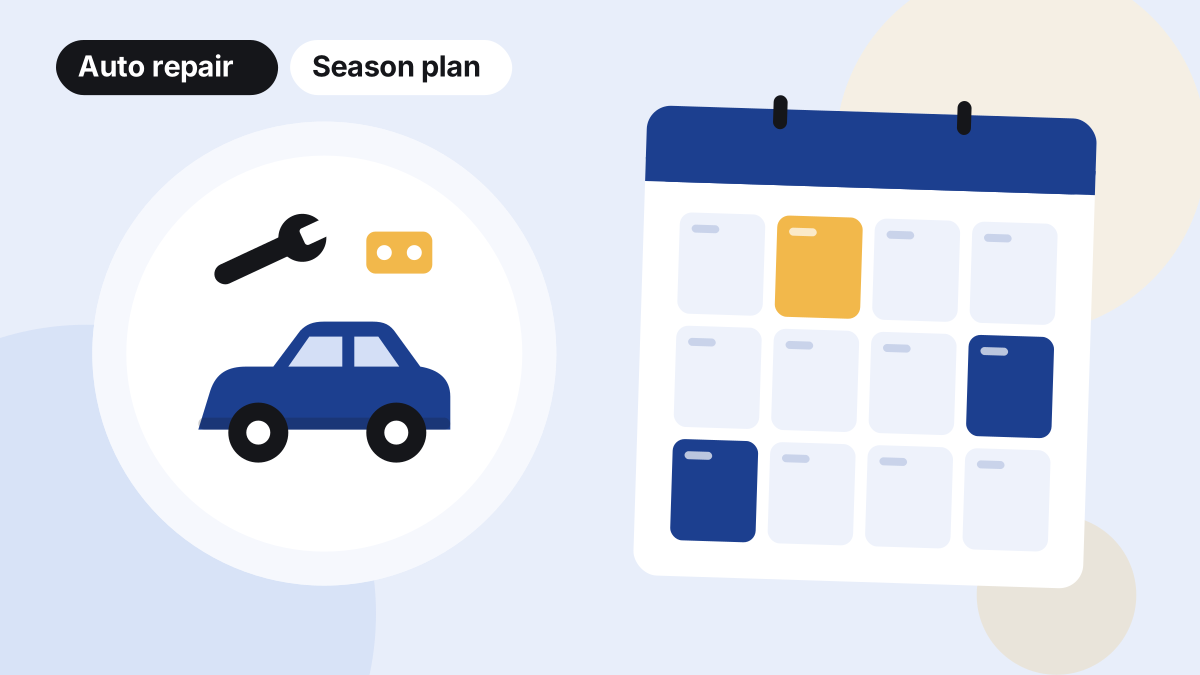
Cold starts, tax refunds and road trips set the shop year

Nobody publishes month-by-month demand for independent shops, so the ratings are how the year usually runs in a four-season state. The reasons come from the IRS, the Car Care Council and AAA. Sun Belt shops trade the winter battery rush for a longer season of AC and cooling work.

Demand through the year for auto repair shops
  1. January: Busy
  2. February: Steady
  3. March: Peak
  4. April: Busy
  5. May: Busy
  6. June: Busy
  7. July: Busy
  8. August: Steady
  9. September: Steady
  10. October: Busy
  11. November: Busy
  12. December: Slow
January
Cold mornings find the weak batteries. The Car Care Council says a battery three or more years old is more likely to fail. Have battery testing on the profile and the site before the first hard freeze, not after it.
Mid-February into March
By law the IRS holds refunds that include the Earned Income Credit until mid-February, and most e-filed refunds arrive about three weeks after filing. The repairs drivers put off over the holidays come back with the refund, so the review count and the brake and suspension pages need to be ready in February.
April
National Car Care Month, when the Car Care Council tells drivers to get tires, brakes and wipers ready for spring driving and summer trips. Send the spring check to your own customer list in the last week of March.
Late June to early July
AAA tells drivers to get routine maintenance done before a summer trip, and its July 4th week roadside calls include dead batteries and flat tires that end up at a shop. Pre-trip inspections sell themselves in June; the breakdown calls arrive in July.
October
Fall Car Care Month. The Car Care Council's advice is to check brakes, tires and heat before winter and to test the battery every fall. It is the second natural reason in the year to contact every customer.
December
The quiet month: holiday weeks, and drivers waiting for refunds before any repair that can wait. Use it to follow up declined estimates and build the February campaigns.

Independent shops with open bays and nothing to hide on the estimate

The Auto Care Association counts more than 270,000 independent repair businesses, and most of them sit a few miles from a dealer service lane. These are the shops a plan like ours moves fastest.

The general repair shop with a few empty bays
Four to ten bays, a good rating on a review count that stopped growing a year ago, and a Google profile that still lists last decade's hours. Profile, review requests at pickup, call handling and service reminders usually move this shop first.
The specialist: transmissions, brakes, tires and alignment, AC
People search for the repair, not the shop, and those searches convert well: LocaliQ's 2026 automotive report puts Transmission & Clutch Repair and Tire & Wheel Repair among the best-converting subcategories. A page and a campaign for each service line is where your budget goes furthest.
The shop courting owners of cars leaving the factory warranty
S&P Global Mobility expects the heavy 2015 to 2019 model years rolling off warranty to feed independent shops. Those owners have been told to stay with the dealer. The FTC says they do not have to, and that is a message you can run.
The California or Florida shop that wants its ads clean
Registration numbers in every online ad in California, written estimates and overrun limits in Florida. If you would rather have someone read every ad against the rules before it runs, that is part of the job here.

Who we would point elsewhere. Shops booked solid three weeks out: more calls would only mean more voicemails and slower turnarounds, so we would help with capacity and reminders first. And shops that want bought reviews, reviews only from happy customers, or a coupon price the counter will not honor. The FTC's review rule and the misleading-ad rules in California and Florida make those a liability, and we will not run them.

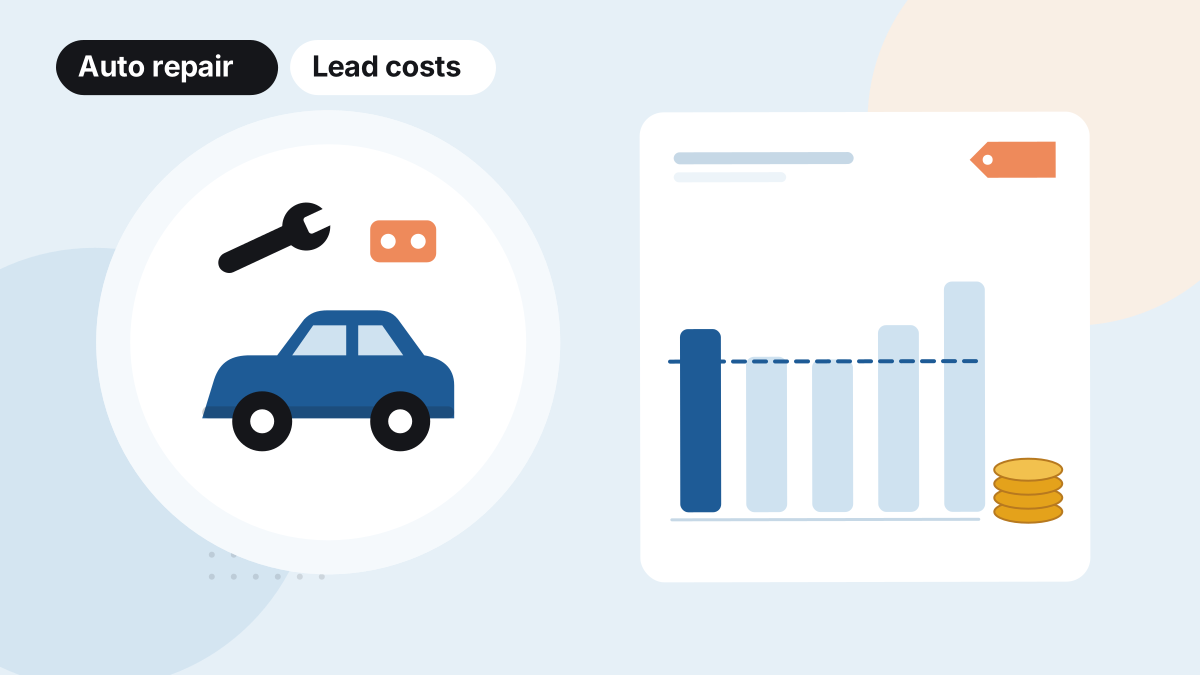
What a repair lead costs on Google search

Published medians for the categories independent shops fall into, not our results. The two reports define the category differently: LocaliQ's Auto Service & Repair is one subcategory of 1,983 automotive campaigns (Apr 2025 to Jun 2026), while WordStream by LocaliQ's Automotive - Repair, Service & Parts pools repair, service and parts sellers, at a $29.96 median cost per lead and a 15.51% conversion rate against 8.18% for all industries (Apr 2025 to Mar 2026). LocaliQ also found Auto Service & Repair clicks up 27.13% in cost while click-through rates fell 7.35%.

$42.10
Median cost per lead on Google search for Auto Service & Repair, at a 15.39% conversion rate, Apr 2025 to Jun 2026
LocaliQ, 2026 Automotive Search Ad Benchmarks
12.9 years
Record average age of light vehicles on the road, which keeps older cars coming to independent bays
Auto Care Association, 2027 Factbook (June 2026)
47%
Of consumers rule out a business that shows under 20 reviews
BrightLocal, Local Consumer Review Survey 2026
58%
Of calls to automotive businesses were answered by a person, averaged across Invoca customers in 2026
Invoca, July 2026
Median cost per search lead, by repair type
  • Tire & Wheel Repair$20.70
  • Tire & Wheel Alignment and Rotation$28.50
  • Brake Repair & Inspection$32.46
  • Transmission & Clutch Repair$34.81
  • Auto Service & Repair$42.10
  • Body Repair & Paint$56.26

LocaliQ 2026 Automotive Search Ad Benchmarks, Apr 2025 to Jun 2026, medians. A tire lead costs well under half a body shop lead, and the general repair category costs more than any single repair inside it, which is the case for campaigns split by service. Source: LocaliQ.

Our plans are affordable for a single-location shop with a handful of bays, and they are scoped to the car count you want to add rather than sold as a bundle. You see the first steps we would take, in writing, before any invoice.

Get your free plan

Local Services Ads, AAA and RepairPal, or your own profile

Three ways a repair shop pays to be in front of a driver who does not know it yet. Most shops use more than one; the difference in this trade is that Google's own trust badge is not on offer.

QuestionLocal Services AdsAAA Approved and RepairPal CertifiedYour own profile, site and reviews
What it costs youPer valid lead, against a weekly budgetRepairPal charges a recurring certification fee; AAA approval means meeting its standards and inspectionsNo media cost; the time it takes to keep it current
Trust mark shownNone: Google says the Google Verified badge is currently unavailable for auto categoriesThe AAA Approved sign, member discounts, the RepairPal Certified listingYour reviews, your warranty and the ASE certifications you hold
What you must showGeneral, professional and garage keepers liability insurance, state licenses where required, a verified Google profileAAA: ASE-certified or factory-trained technicians. RepairPal: a warranty of at least 12 months or 12,000 miles and customer surveysCorrect categories and services, and in California the BAR registration details on the site
Leads it will not refundLeads that arrive outside your business hours, and calls you miss and return still countNot a per-lead product, so the test is cars per month against the feeNo refunds needed, since you decide what it says
Who sees itDrivers searching repair categories in your areaAAA members and drivers browsing RepairPalEveryone who searches for your shop or a repair near you
Best atCalls for a named repair, when someone answers liveProof for a driver who has never heard of youCatching the referred driver and the ad click that checks you first

Google is shifting its Local Services Ads product into Google Ads in stages. Auto was not named in the August 2026 first phase, and the remaining categories are scheduled for late 2026 and 2027. After the move, pay per lead and the Search and Maps placements stay, and manual bidding goes.

Count repair orders first, then get the shop found

For a repair shop we run Clear and Found together, Chosen alongside them, and Kept from about the fourth week. The reason is cost: clicks are getting more expensive in this category, so nothing should scale until it is measured against work that came through the bay door.

Clear

Knowing which work produced which jobs.

LocaliQ's 2026 automotive report shows Auto Service & Repair clicks costing 27.13% more while click-through rates fell. Only a lead matched to a repair order in your shop management system tells you whether that rise is paying for itself.

Found

Being the company that shows up when someone searches.

The map pack is where the driver with the warning light decides, so categories, services, hours and the state-registered name go right first. Local Services Ads screening takes three to four weeks on Google's own estimate, so it starts in week one.

Chosen

Being the one they pick once they have found a few.

Drivers arrive expecting to be upsold. Recent reviews, the certifications you actually hold, your parts and labor warranty and the FTC's point about factory warranties answer that before the phone rings.

Kept

Turning one job into the next one and the referral.

Maintenance comes back around. Reminders by mileage and date, follow-up on work a customer declined, and the April and October car care checks bring back cars you have already earned once.

Weeks 1 to 2

Call tracking on every channel and one agreed definition of a lead: a booked appointment. Leads are matched to repair orders in your shop software, so cost per car can be read by source.

Weeks 1 to 6

Profile categories, services and hours corrected. The registered name, and in California the ARD number and registered phone, put on the site and in every ad. Local Services Ads screening begins and search campaigns are split by service line.

Weeks 2 to 8

A review request by text at pickup for every customer, a reply to every review in your own words, and your warranty, certifications and the FTC warranty point written onto the site.

Weeks 4 to 12

Service reminders by mileage and date, declined-work follow-up, and missed-call text-back or a voice agent that books appointments while the bays are busy.

Five ways repair shops lose cars, or hear from the state

A California ad with no ARD number

The Bureau of Automotive Repair says every online ad must show the business name as registered, the automotive repair dealer registration number and the registered phone, and the website must show them too, for example in the footer. A Google profile name that has drifted from the registered one is a common slip. Use one name, number and phone everywhere.

Coupon prices the counter will not honor

California treats an ad that tends to deceive the public as misleading, read as a whole the way its audience reads it, and Florida bans false promises likely to get a customer to authorize a repair. Advertise the price your service writer will actually quote, and say what it includes.

Leaving dealer-loyal owners to the dealer

The FTC says it is illegal for a dealer to deny warranty coverage because maintenance was done somewhere else, and aftermarket or recycled parts do not void a warranty either. Say it on the site and in ads, and keep service records a customer can show the dealer.

A phone that rings out while every tech is under a car

Fewer than 3% of callers sent to voicemail leave a message, in Invoca's platform data. Local Services Ads treats missed calls as a mark against your responsiveness and will not credit leads that arrive outside your listed hours. Cover the phone, text back missed calls, and keep the hours accurate.

Paying for reviews, or asking only the happy customers

The FTC's 2024 review rule bans fake and insider reviews and rewards tied to a positive or negative review. Ask every customer at pickup by text, and answer every review yourself: a shop that replies to a complaint about an estimate in plain words wins more trust than a perfect score.

The warranty sentence a repair shop can say out loud

Every independent shop competes with a sentence the dealer’s service writer never says: you do not have to come back here to keep your warranty. The FTC says it plainly on its consumer pages. It is illegal for a dealer to deny warranty coverage because routine maintenance or repairs were done by someone else, and a warranty stays in effect when aftermarket or recycled parts are used.

There are limits, and a shop that states them sounds more credible than one that does not. If a defective or badly installed part causes damage, the maker can refuse to cover that damage, but it must first show the part was the cause. And when the warranty says certain work will be done for free, the maker can require its own facility for that work. Everything else, the oil changes, brake pads, belts and inspections, can be done at your shop without risk to the owner’s coverage.

That turns into marketing in three places:

  • On the site and in the ads. One plain line near the booking button, in the words the FTC uses, does more for a three-year-old car’s owner than any coupon.
  • On the invoice. The FTC tells owners to keep records of oil changes, tire rotations, belt replacement, new brake pads and inspections. A shop that keeps a clean digital service history the customer can show a dealer removes the last reason to go back.
  • In the reminders. S&P Global Mobility expects the heavy 2015 to 2019 model years rolling off warranty to feed the aftermarket. A reminder that names the mileage, not just the date, is the one that gets opened.

The data side is still unsettled. Massachusetts law requires makers that use telematics to give vehicles from model year 2022 onward an open, standardized platform, so that with the owner’s authorization an independent shop can reach the car’s mechanical data. There is no federal equivalent: in June 2026 the Auto Care Association was still urging Congress to pass the REPAIR Act, which means it was a bill, not a law. We do not write ads that promise more access than your state gives you. We do write the warranty sentence onto every page that a nervous new-car owner is likely to read.

What your shop gets in the free plan

Any shop that contacts us gets a free consult, a straight assessment of where it stands and a written plan to keep, hired or not. For an auto repair shop, that covers:

Get your free plan
  • Where you show up for "auto repair near me" and two repairs you want more of, such as brakes or transmissions, and which nearby shops currently own the three map spots and the paid repair listings.
  • Your Google profile against your registration: categories, services, hours, photos of the bays, and whether the name matches the one on file with the state.
  • Your reviews read the way a wary driver reads them: how many from the last three months, the star average and how the replies sound.
  • Your ads and coupons read against your state's rules, including the BAR registration details if you are in California.
  • What happens to a call when everyone is in the bays, and a 90-day order of work that names what we would not touch.

What shop owners ask before they let anyone near their ads

Are Local Services Ads worth running for a repair shop?

Sometimes, but they lose their best feature in this trade. Google says the Google Verified badge is currently unavailable for auto categories, so the ad runs without it, after screening that includes garage keepers liability insurance. You pay per lead, and leads outside your listed hours are not credited. We usually test them against search ads split by repair type before recommending either.

What should a repair lead cost me?

The published medians are $42.10 for Auto Service & Repair on Google search (LocaliQ, Apr 2025 to Jun 2026) and $29.96 for WordStream by LocaliQ's broader repair, service and parts category (Apr 2025 to Mar 2026). Tire leads run cheaper and body work dearer. A lead is not a repair order, so we report cost per booked job, not per lead.

Can I tell drivers they can skip the dealer without losing their warranty?

Yes, because the FTC says so. It is illegal for a dealer to deny warranty coverage because routine maintenance or repairs were done elsewhere, and using aftermarket or recycled parts does not void it; the maker has to show the part caused the damage before denying a claim. The exception is work the warranty says will be done free, which the maker can send to its own facility.

What do I have to put in my ads in California?

Your business name as registered with the Bureau of Automotive Repair, your automotive repair dealer registration number and your registered phone, in every online ad and for each location an ad lists. The same details go somewhere easy to find on your website, such as the footer. A mobile repair vehicle carries the registration number in at least 72-point type.

Do the Florida rules change what I can advertise?

They change what you can promise. Florida requires a written estimate before diagnostic or repair work that will exceed $150, limits going over the estimate to $10 or 10 percent, capped at $50, without the customer's consent, and bans false promises likely to get a customer to authorize a repair. Ads should say what the counter will actually quote.

Which badges are worth putting in my ads?

The ones you hold, explained. An ASE Blue Seal shop has at least 75% of its employees ASE certified; AAA Approved Auto Repair requires ASE-certified or factory-trained technicians; RepairPal Certified requires a warranty of at least 12 months or 12,000 miles. The FTC tells drivers to look for certifications but not to treat them as a guarantee, so pair them with reviews and your own warranty.

How many Google reviews does a shop need?

Twenty is the floor, and fresh ones count more. Nearly half of shoppers, 47% in BrightLocal's 2026 survey, rule out a business showing under 20, and readers give the last three months the most weight. A text at pickup with the direct link, sent to every customer, keeps the count moving. How we run review requests.

Should I market EV repair?

As a sign that you keep up, yes; as your main line, not yet. The Department of Energy notes that many makers warrant EV batteries for 8 years or 100,000 miles and that electric cars need less routine maintenance. Hybrids are reaching independent bays sooner, and that is where we would put the copy first.

Can you bring in the big jobs, not only oil changes?

Yes, in two ways. Transmission and brake searches convert well, so they get their own pages and campaigns. And in our experience the oil-change customer is where the next brake job is found, so follow-up on declined work is set up alongside the ads, not after them.

What happens to my Local Services Ads when Google moves them into Google Ads?

Not much yet for a repair shop. Auto was not named in the August 2026 first phase; the remaining categories are scheduled for late 2026 and 2027. When it happens, pay per lead and the placements stay, manual bidding goes, and insurance and license reverification are no longer required.

See what a wary driver sees before trusting you with the car

Tell us the shop, the city and the work you want more of: brakes, transmissions, diagnostics, fleet. You get back where you rank for those searches, how your profile and reviews read to a driver who expects to be upsold, whether your ads include the details your state asks for, and the first changes we would make.

  • A free consult. A real conversation about your business, your area and what is not working yet.
  • An honest evaluation. Where you stand in search, ads and follow-up next to the businesses you lose customers to.
  • A plan you keep. What we would fix first and why. It is yours whether or not you work with us.

Form not loading? Email hello@beyaoshy.com and we will reply within one business day.

Sources

The figures on this page come from these published sources, checked on October 3, 2026. Benchmarks are averages across many advertisers; your market will differ, which is what the free plan is for.

Agencies with auto repair shops among their clients: see the partner model.