Skip to content

Wedding and event venue marketing for the couples booking next October this winter

October is the most popular month to get married, and the couples who will fill next October's Saturdays get engaged around Christmas and tour in January. They find you on The Knot, WeddingWire, Zola, Instagram and Google, write to about seven vendors, and half of them expect an answer within a day. We make your venue the one they tour: capacity and photos that answer their questions, a reply that goes out while you are running Saturday's wedding, and buyers of their own for Fridays, Sundays and January.

Taking on new event and wedding venues now

Reviewed by Niomi Ascot on

Venues that rent a date, a room and a first impression

The Knot's 2026 study found 89% of couples book a venue and 83% call it the most important choice they make, and WeddingPro's 2025 venue report found 82% hire the venue before any other vendor. Everything else in the wedding waits on you. These are the venues we help most.

The garden, barn or estate that lives on one marketplace

Garden venues were the top choice for the second year running in Zola's 2026 report, with farms, barns and ranches close behind. If nearly every tour starts with a marketplace inquiry, the work is a website, Business Profile and follow-up you own, so one platform's ranking change does not empty next year's calendar.

The banquet hall with its own kitchen

Weddings, quinceañeras, company dinners and holiday parties, each with a different buyer and a different lead time. Federal industry codes even file banquet halls with catering staff alongside caterers. Each buyer gets its own page, its own inquiry questions and its own season.

The private room or winery chasing weekday and winter dates

Zola tells couples to ask venues about off-season dates and days of the week. Those couples, plus rehearsal dinners, showers, brunches and company events, are the buyers for a quiet Thursday in February, and they search with different words from a Saturday wedding.

The group with several rooms or properties

Every room needs its own capacity by layout and its own photos, and a property with its own address and permanent signage can carry its own Google profile. One tracking setup across all of them shows which room's ads turn into tours.

Who we would point elsewhere. Venues still waiting on an occupancy placard or an assembly permit. New York City requires a Place of Assembly certificate once 75 or more people gather indoors, and Chicago's Public Place of Amusement license needs the occupancy placard first, so we will not advertise dates you cannot yet legally host. A venue booked solid two years out does not need us yet. And if you want a guaranteed number of weddings, nobody honest can promise one, and we would rather say so on the first call.

Where couples and planners meet a venue before they ask for a tour

Ranked by how many inquiries each usually sends a venue that leans on weddings. Most couples see you in at least two of these before they write, and check the rest before they book a tour.

  1. Wedding marketplaces: The Knot, WeddingWire, Zola

    Nearly three couples in four (73%) use a planning site or app to look for their venue, by The Knot's 2026 count. The Knot and WeddingWire belong to one company, so a storefront plan covers both. WeddingPro, which sells their listings, says 91% of couples planning on them also hire a venue there; that is its own claim, and the reason to track tours by source.

  2. Google Search and Maps

    Searches such as "wedding venues near me", "banquet hall" or "event space" with a city. In Whitespark's 2026 survey of local ranking factors, the main Business Profile category and how close the address sits to the searcher lead the map pack list, so the category has to say what the place is. Google also names event venues among the businesses that should not post opening hours.

  3. Pinterest, Instagram and TikTok

    In Zola's 2026 report, 77% of couples use Pinterest for inspiration and half get ideas from TikTok, and couples admit picking a venue because it will look great in photos. Real weddings in your rooms, tagged with the venue's name, send them looking for you.

  4. Planners, vendors and past guests

    Referrals carry more weight in the South, where 46% of couples hired a planner in WeddingPro's 2025 venue report. A planner who knows your load-in times and your capacity by layout recommends you without being asked.

  5. Corporate and party listing sites

    Holiday parties, offsites and galas are booked by an office manager, an executive assistant or a planner on a much shorter clock than a wedding. Sites such as Eventective, which says it reaches more than 1.5 million visitors a month, are where some of them shop.

  6. AI assistants

    BrightLocal's 2026 review survey put the share of consumers turning to AI tools such as ChatGPT for local suggestions at 45%, against 6% the year before, and Zola found 54% of couples use AI somewhere in planning. An assistant can only describe your capacity, layouts and policies if they are written down in public.

October fills the room, but December fills the order book

A venue runs on two calendars. The bars show inquiries and tours, which follow engagements: The Knot's 2026 study names December the top month to propose and finds most couples, nearly 60%, begin planning in under four weeks, so the ratings are our reading of that timing rather than a measured count. The events run the other way, with 76% of weddings between May and October.

Demand through the year for event and wedding venues
  1. January: Peak
  2. February: Peak
  3. March: Busy
  4. April: Steady
  5. May: Steady
  6. June: Steady
  7. July: Steady
  8. August: Steady
  9. September: Busy
  10. October: Busy
  11. November: Busy
  12. December: Peak
Thanksgiving to Valentine's Day
Around 40% of proposals happen in this window, and Christmas Day is the most popular single day to get engaged (The Knot, 2026). Galleries, capacity pages, the inquiry form and the campaigns need to be live before Thanksgiving, not built after New Year.
January and February
Zola advises booking June, September and October weddings 12 to 14 months ahead, so next year's best Saturdays sell now. Reply within a day and offer a tour time in the first message.
May to October
The months you are busiest running events are the months inquiries are steadiest, not highest. Keep the after-hours reply on, and ask every couple for a review in the weeks after the wedding, not only the ones who sent a thank-you card.
September and October
Two of The Knot's top five 2026 dates fall in September, and October held 17% of 2024 weddings in its 2025 study. Company holiday parties are booked at the same time: Challenger, Gray & Christmas found 64% of companies planning one in 2024.
January to April events
Zola puts January to March weddings three to six months out and tells couples to ask about off-season rates and weekdays. These dates need their own message and their own buyers: rehearsal dinners, which 75% of 2025 weddings had, brunches, showers and company events.

A venue wins the tour before it wins the search

Most local businesses need to be found first. A venue usually already has a marketplace storefront and an Instagram account sending couples its way. What leaks is the next step: the website they check, the reply they wait for, the tour nobody offered.

Chosen

Being the one they pick once they have found a few.

Couples look for photos that match their style, a clearly listed guest capacity and transparent pricing and availability, WeddingPro reported in 2025. Real-event galleries for each layout, capacity written as seated and standing, and a tour calendar on the site come first. Whether to show your own starting price is your decision.

Clear

Knowing which work produced which jobs.

Engagements ran 14 months on average for 2025 weddings in The Knot's study and 18 months among Zola's 2026 couples, so a contract can land a year after the first click. Every inquiry is tagged by source, event type and date requested, and followed to tour and contract, before any budget moves.

Found

Being the company that shows up when someone searches.

A Business Profile with the right primary category, no posted hours and real event photos, then Google search ads on venue and event terms, weighted to engagement season rather than to the summer you are already full.

Kept

Turning one job into the next one and the referral.

WeddingPro reports that following up on days 1, 3, 9, 14, 20, 26 and 30 makes couples nearly 40% more likely to respond. Past couples come back for anniversaries and send friends, and this December's holiday party client books again if someone asks in January.

Weeks 1 to 2

Your marketplace storefronts, Business Profile and website on a phone read side by side, the reply time on your last 20 inquiries, and the count of reviews posted since the spring or the last season ended.

Weeks 3 to 6

Capacity by layout, a gallery of real events for each room, an inquiry form asking date, guest count and event type, a tour booking calendar, and an after-hours reply that offers a tour time while you are on the floor.

Weeks 7 to 10

Tracking from inquiry to tour to signed contract, then Google search ads and retargeting aimed at engagement season and at the dates still open this year.

Weeks 11 to 13

Review requests to every recent couple and corporate client, outreach to last year's holiday party bookers, and the first report on cost per tour and per contract.

From the inquiry form to the signed contract: four places a venue drops couples

A venue pays for the marketplace listing and the search ad, and the couple arrives already interested. What loses them is the form that asks too much, the date that is taken, the tour nobody can schedule and the hold that quietly expires.

An inquiry form that asks for the whole wedding

HubSpot's look at more than 40,000 landing pages found conversion fell only slightly as single-line fields were added, but pages with several multi-line text boxes or several drop-down menus converted clearly worse. The data is old, correlational and mostly from business forms, and plenty of venue forms still ask for budget, vision and a vendor list before a couple has toured.

The fix. Cut the form to name, email or phone, event date (or "flexible"), guest count and event type, and put a tour calendar right after it. Everything else, from budget to the ceremony layout, belongs in the tour conversation, where you can answer back.

The date is taken, and the reply just says so

In our experience the reply a busy venue sends most often is "Sorry, that date is booked," and it ends the conversation with a couple who has already decided they like the place. The date is the first thing they asked about, not the only thing they would accept.

The fix. Never send a booked-date reply without alternatives: "June 13 is taken, but we have Friday the 12th and Sunday the 14th, and Saturday, September 26 if fall works. Would any of those be worth a tour?" If you price Fridays and Sundays differently, say so in the same reply. Keep a short list of open Fridays, Sundays and off-season Saturdays where whoever answers inquiries can see it.

Tours booked by phone tag

A couple who writes at 10 p.m. and gets "call us to set up a tour" the next afternoon has to catch you during working hours, which is when they are at work. In our experience every round of phone tag loses a share of them to the venue with a booking link.

The fix. Put a link to a tour calendar in the first reply, with the slots you actually staff, including one weekday evening and Saturday mornings outside your event hours. Confirm the day before by text or email with parking, the entrance to use and who will meet them: "See you Saturday at 10, Amy and Jordan. Park by the barn doors; Kate will meet you at the gate."

A courtesy hold that expires without a call

Many venues offer a short hold on a date after a tour, and in our experience it is the most valuable moment in the sale: the couple has seen the room and pictured the day. A hold that lapses with no contact gives the date back to the calendar and the couple to whoever called them.

The fix. Send a thank-you the same evening as the tour, with photos of the room set the way they described and the hold date in writing. Call two days before the hold expires: "Your hold on October 10 runs out Friday. Do you have everything you need to decide, or would it help to see the contract first?" If they need longer, say how long you can extend it and whether anyone else has asked about the date.

What a venue inquiry costs when nobody publishes a venue category

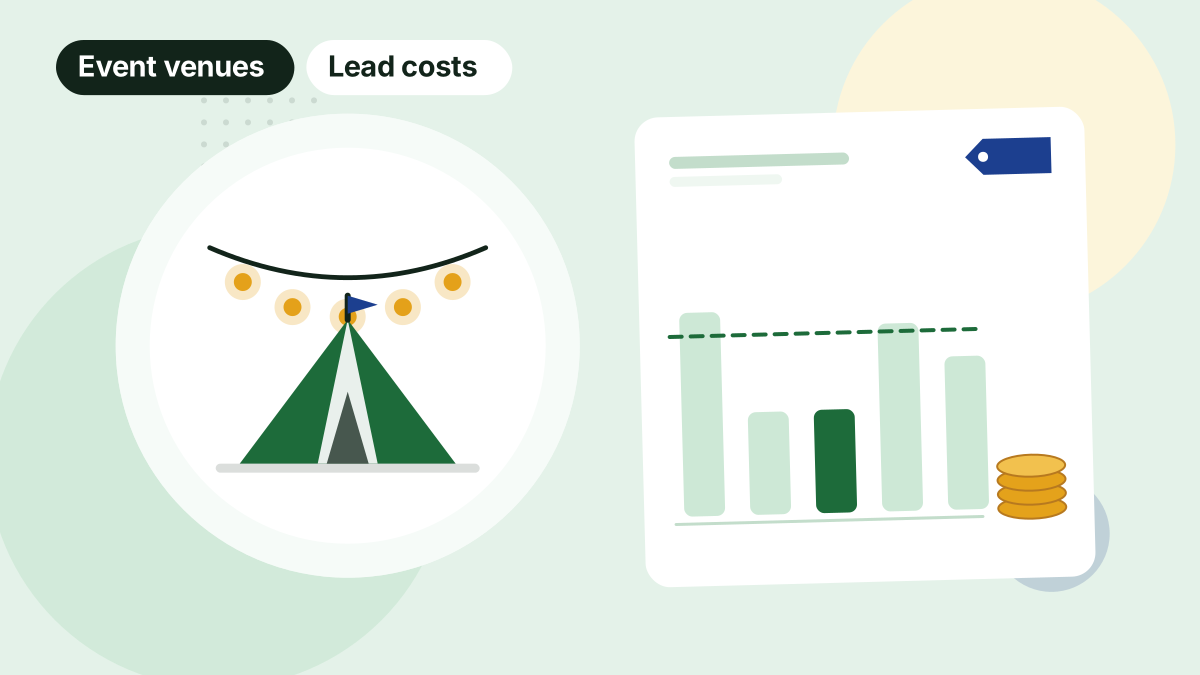
No benchmark publisher reports event venues on their own. The nearest is WordStream's Personal Services category, which it says includes wedding planners, with Arts & Entertainment beside it for party and entertainment spaces. Each figure is the middle value across hundreds of advertisers; none predicts what your venue will pay, and none is a result of ours. With engagements running more than a year, judge them on cost per tour and per contract.

$54.60
The middle Google search cost per lead, April 2025 through March 2026, in Personal Services, the category with wedding planners in it
WordStream by LocaliQ (2026 edition)
73%
Share of 10,474 couples married in 2025 who used a planning site or app in the search for their venue
The Knot, couples study published 2026
24 hours
The longest wait for a reply that one couple in two will accept from a vendor, and the average couple writes to seven
WeddingPro, October 2026
89%
Of couples book a venue, and 83% say it was the most important choice they made
The Knot, 2026 study of 2025 weddings
What one lead costs, middle values for the nearest published categories
  • Personal Services, Google search (12 months to March 2026)$54.60
  • Arts & Entertainment, Google search (same 12 months)$26.84
  • All industries together, Google search (same 12 months)$66.69
  • Personal Services, Facebook lead campaigns (April 2025 to June 2026)$38.09

WordStream's 2026 Facebook report says Personal Services lead costs rose 24.60% and notes the longer sales cycle in the category. Social form leads usually need more follow-up before a couple books a tour. Sources: Google benchmarks, WordStream by LocaliQ; Facebook benchmarks, WordStream by LocaliQ.

Our plans are affordable for a single property whose owner also runs the events, and they are built around the dates you need to fill rather than a fixed bundle. You see the first steps in writing, free, before you pay us anything.

Get your free plan

Wedding marketplaces, Google search ads or a site and profile you own

Google has no Local Services Ads category for venues, so folding those ads into Google Ads, which began in August 2026, does not touch you. These are the three ways a venue actually pays for inquiries. Most use all three; the question is which one books tours at a cost you can carry.

QuestionThe Knot, WeddingWire and ZolaGoogle search adsA website and Google profile you run
What you are paying forA listing or advertising package set by each platform; get what is included in writingEach click on the adNothing to the platform; staff hours for photos, capacity and replies to reviews
Who else hears from the coupleUsually several venues from the same search, since a couple writes to seven vendors on average (WeddingPro)Competitors bidding on the same searchNobody; they came looking for you by name or from a referral
What the inquiry tells youWhatever the platform form asksWhatever your landing page asksYour own questions: date, guest count, event type, and a tour time
Who holds the recordThe platform holds the conversation and your reviews thereYou hold the landing page and the data in your accountYou hold the site, the form data and the profile you manage
Corporate and off-peak buyersBuilt around weddingsCan bid on "holiday party venue" or "meeting space" separatelyOne page per event type can rank and convert for each
Best atCouples early in planning, comparing many venuesCouples and planners searching your city by needTurning a curious couple into a booked tour

Google's Local Services Ads list has no event venue category. WeddingPro's audience and booking figures are the platforms' own claims; we report how many of your tours and contracts each source actually produced.

Mistakes that cost venues the tour, not just the click

One capacity number for every layout

The Illinois State Fire Marshal's guidance uses 15 square feet per person for guests at dining tables and 7 for chairs set in rows, so one room can hold about twice as many for a ceremony as for dinner. A couple who reads "up to 300" and tours a room that seats 150 for dinner does not book. List ceremony, seated and standing numbers.

Opening hours on Google, as if you were a shop

Google's guidelines say event venues should not list hours. Posted hours invite walk-ins and show "Closed" to a couple browsing at 9 pm. Leave them off and put the tour calendar one tap away.

Answering Saturday's inquiry on Monday

Couples give a vendor about a day: half expect to hear back within 24 hours, and each is writing to seven. The venue running a wedding all weekend is the one that loses the weekend's inquiries, so after-hours replies and a tour link belong in place before the season starts.

Spending most in the months you are already full

Budgets that peak in June miss the winter wave of newly engaged couples choosing next year's Saturdays. Weight spend toward Thanksgiving to Valentine's Day, and keep a separate budget for the specific dates still open this year.

Asking only the happy couples for reviews

The FTC's review rule took effect on October 21, 2024, and its guidance says asking only customers you expect to be happy could violate the FTC Act. Ask every couple and every corporate client. WeddingPro says reviews help most when a vendor has at least five from the last two years.

One room, two capacities, and a permit behind both

Capacity on a venue’s website is usually one number, and it is usually the biggest one the room can hold. The fire code does not read it that way. Under NFPA 101, as the Illinois State Fire Marshal explains it, a room becomes assembly use at 50 or more people, and the occupant load depends on how the floor is used: 15 square feet per person, net, for guests seated at dining tables, and 7 square feet for a dance floor or chairs set in rows. The same room holds roughly twice as many people for a ceremony as it does for dinner. Zola tells couples that maximum capacity is non-negotiable, and the couples who read that will ask.

So we write capacity by layout: ceremony, seated dinner, cocktail reception, and which of those can share one room on one night. It spares a couple of 180 a wasted drive to a room that seats 150 for dinner, and it gives search engines and AI assistants a specific answer to the question couples actually type.

Permits sit behind those numbers, and they change from city to city. New York City requires a Place of Assembly Certificate of Operation where 75 or more members of the public gather indoors, or 200 or more outdoors, including to eat and drink. Chicago requires a Public Place of Amusement license to rent out a facility for a party or event open to the public. It needs an occupancy placard from the Department of Buildings, runs for two years, and is not allowed within 200 feet of a church, school or hospital unless a reduction is granted. We do not advertise dates or headcounts a venue is not cleared to host.

Alcohol is the other rule that shapes the copy. A venue either holds its own license or works with licensed caterers. Texas, for one, grants the caterer’s permit only to businesses already holding a mixed beverage permit, and catered events at public facilities such as museums or community centers need a letter from the facility granting permission. Your site should say plainly which model you run, because it changes the quote and the vendor list a couple has to assemble. And if your ads mention the bar, Google’s alcohol policy applies: they must not target, or be designed to appeal mainly to, people under the legal purchase age.
Your free venue plan, and what is in it

The first consult is free and the evaluation is a straight one. The written plan is yours to keep either way. For a venue it includes:

Get your free plan
  • Where you appear for "wedding venues" and "event space" searches in your area and the nearby towns couples also search, and which venues hold the map pack.
  • Your marketplace storefronts and Business Profile read side by side: categories, posted hours, photos, capacity and how recent your reviews are.
  • A test inquiry through your website and one marketplace, timed, with what the reply said and whether it offered a tour.
  • Your open dates for the coming twelve months set against the engagement calendar, with the Fridays, Sundays and winter dates that need buyers of their own.
  • Ninety days of work for your venue, in the order we would do it, and what we would not touch.

What venue owners ask before a first call

Is The Knot or WeddingWire worth it, or should we spend on Google instead?

Usually both, for different jobs. Most couples, 73% in The Knot's latest study, search for their venue on a planning site or app, so the storefront matters. Google catches couples and planners searching your city by need, and your own site is where the tour gets booked. We track which source produced each tour, so both are judged on bookings.

Can a venue run Local Services Ads?

No. Google's Local Services Ads category list has no venue category, so the Google Verified badge and pay-per-lead format are not available to venues. Google search ads on venue and event terms do the job instead.

What should one inquiry cost us?

Nobody publishes a venue-only benchmark. The nearest is WordStream's Personal Services category: a $54.60 median cost per lead on Google search from April 2025 to March 2026, and $38.09 for Facebook lead ads from April 2025 to June 2026. Use them as a reference point and judge your own cost per tour.

When should we advertise for next year's weddings?

Before Thanksgiving. Around 40% of proposals happen between Thanksgiving and Valentine's Day, most newly engaged couples start planning within weeks, and Zola advises booking June, September and October dates 12 to 14 months ahead.

How do we fill Fridays, Sundays and winter dates?

With buyers other than Saturday couples. By The Knot's count, 75% of 2025 weddings had a rehearsal dinner and 21% a day-after brunch, and Challenger, Gray & Christmas found 64% of companies planning holiday parties in 2024. Each gets its own page, search terms and inquiry questions. Pricing those dates stays your decision.

Should our website show prices?

That is your call, and there is a case for it. WeddingPro found couples look for transparent pricing and availability alongside capacity and photos. A starting point with what it includes answers the question without committing you to a final quote before the tour.

Who answers inquiries while we are running a wedding?

An after-hours agent can. It replies on the site and by text, asks the date, guest count and event type, offers a tour time and hands the conversation to your team in the morning. WeddingPro says a reply inside one day is what half of couples expect. How our agents handle it.

Do Google reviews matter if we already have hundreds on The Knot?

Yes. BrightLocal's 2026 survey found Google is still the most used review source, at 71% of consumers, and assistants that recommend venues draw on what is public. Ask every couple for both, with no reward tied to a positive review.

Can you show which channel booked a wedding?

Yes, if every inquiry carries its source through to the tour and the contract. We report tours and signed dates by source rather than clicks, with marketplace inquiries in the same view so the channels are compared fairly.

See your venue the way a newly engaged couple does

Tell us the venue, the city, your capacity and the dates you most need to fill. You get back how you show up on Google and the wedding sites against the venues couples compare you with, how quickly a test inquiry was answered, and what we would change ahead of Thanksgiving.

  • A free consult. A real conversation about your business, your area and what is not working yet.
  • An honest evaluation. Where you stand in search, ads and follow-up next to the businesses you lose customers to.
  • A plan you keep. What we would fix first and why. It is yours whether or not you work with us.

Form not loading? Email hello@beyaoshy.com and we will reply within one business day.

Sources

The figures on this page come from these published sources, checked on October 3, 2026. Benchmarks are averages across many advertisers; your market will differ, which is what the free plan is for.

Agencies with event and wedding venues among their clients: see the partner model.