AI Overviews are live. What local results do now
Google turned AI Overviews on for everyone on May 14, 2024. What changed above the local pack, where the early answers get it wrong, and what feeds them.
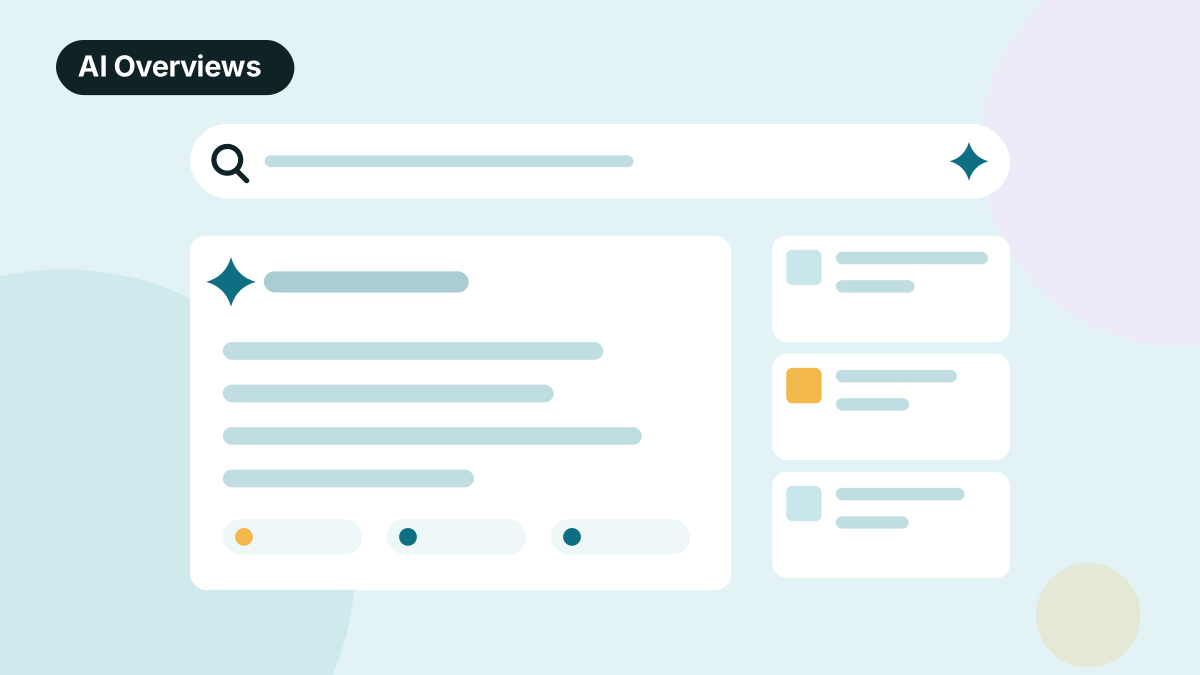
On Tuesday, May 14, 2024, at I/O, Google announced that AI Overviews are rolling out to everyone in search, not just to people who opted into the Labs experiment we have been watching since May 2023. By Wednesday morning they were showing up in the accounts we run, on queries that used to be a straight list of three listings and a map.
The week was noisy for other reasons too. OpenAI put out GPT-4o the day before, and half the marketing newsletters in your inbox spent Monday on that. This is the one that actually changes what a patient or a homeowner sees when they search for you, so this is the one we have been pulling apart.
What it looks like on a local search
Two days is not enough to talk about traffic. It is enough to sit with a browser and look, which is what we have been doing across dental, med spa and home services accounts.
A few patterns so far.
Purely navigational searches are untouched. Somebody typing your practice name still gets your listing and your site, and no summary appears at all. That is most of your branded volume and it is fine.
Broad research questions are where the summary shows up hardest. “Is a dental implant worth it”, “how long does a crown last”, “what does a mini split cost to install”. These get a paragraph, a few bullets, and links out to the side. If you have been writing patient education pages to catch that traffic, expect fewer clicks off those queries.
The “near me” searches are a mixed picture. On plenty of them there is no summary and the map pack sits where it always did. On others a summary appears above everything, describes what to look for in a provider, and then the map pack follows underneath. The listings did not move. They moved down.
Where the early answers go wrong
We check the answers Google gives about our own clients before we tell anyone what to do about it. Some of what comes back is fine. Some of it is not, and the failures rhyme:
- Old hours and old services. One practice stopped taking a plan in 2023, removed it from the site, and the summary still says they take it. The source was a directory page nobody has updated.
- Two businesses merged into one. Similar names in the same metro, blended into a single description with the wrong phone number attached.
- A price that was never on the site. Pulled from a national average article and presented as though it were local.
- A closed location. Not on the profile, not on the site, still living in an aggregator.
- Confident answers to clinical questions that a dentist would not phrase that way. Not our problem to fix, but worth knowing what a patient read before they called.
The pattern underneath all of it: where your own pages are thin, out of date or silent on a question, something else fills the gap, and the something else is usually a directory you do not control.
What actually feeds these answers
There is no separate lever to pull. The summary is built from the same web Google already indexes plus what it knows about your business, so the inputs are the ones you already had:
Your profile. Hours, services, categories, the description, the attributes. Google has been leaning on profile data for local answers since long before this, and it leans harder now that AI Overviews are live. A profile with an accurate service list is doing more work in May 2024 than it did in April.
Your own pages, written in a way that answers the question directly. Not a 2,000 word essay with the answer buried in paragraph nine. A clear heading that asks the question the way patients ask it, followed by a short, specific answer, then the detail. That format was good for featured snippets and it is good for this.
Your reviews, and your replies to them. Review text is public writing about your business that you did not write, which makes it exactly the kind of source a summary reaches for.
Consistency across directories. The stale listing you ignored because it sent no traffic can now be quoted back to a patient in a sentence that looks official.
One related note: Google began enforcing its site reputation abuse policy on May 5, aimed at the coupon and “best of” sections that big publishers rent out to third parties. If some of your category’s directory pages thin out in the months after that, that is why. Do not count on it. Fix your own entries.
What to do this month
- Search your own top five questions and your top three “near me” phrases, signed out, and screenshot what comes back. You want a record of what this looked like in May 2024.
- Read any AI Overview that mentions your business word by word. Note every fact that is wrong and where it plausibly came from.
- Fix those sources in order: your website, your Google Business Profile, then the directories, then the aggregators feeding the directories.
- Pick your ten most common patient or customer questions and give each one a clear heading and a direct two sentence answer on your own site.
- Check your analytics for the pages that live on informational queries and note where they stand now, before the picture blurs.
- Do not panic about the map pack. It has not changed. It is further down some pages.
The thing nobody can tell you in the first week is how this settles, and anyone giving you a percentage two days in is making it up. What we do know is that the inputs have not changed, they just count for more. That means AI search visibility work looks a lot like the local search work we were already doing, with more attention on which sources are speaking for you. If you only do one thing this month, make it your business profile, because it is the fastest thing to correct and the most often quoted.
You made it to the end. Now let's get you more customers.
AI Search Visibility is part of what we set up and run every day, along with the search, ads and follow-up around it. Tell us about your business and we will send back what to fix first. Platforms change every year, so we will check what still holds for you today.
- A free consult. A real conversation about your business, your area and what is not working yet.
- An honest evaluation. Where you stand in search, ads and follow-up next to the businesses you lose customers to.
- A plan you keep. What we would fix first and why. It is yours whether or not you work with us.
Form not loading? Email hello@beyaoshy.com and we will reply within one business day.