Answering service or AI voice agent for a med spa
A live answering service and an AI voice agent both catch a med spa's missed calls. How each works, what to ask about privacy, and which fits which spa.
The weeks before the holidays are among the busiest of the year for a med spa. Clients want injectables and facials before parties and family photos, gift card buyers ring on their lunch break, and the front desk is checking someone out while two more lines light up. Every call that reaches voicemail this month is a consultation that may be booked at the spa across town instead.
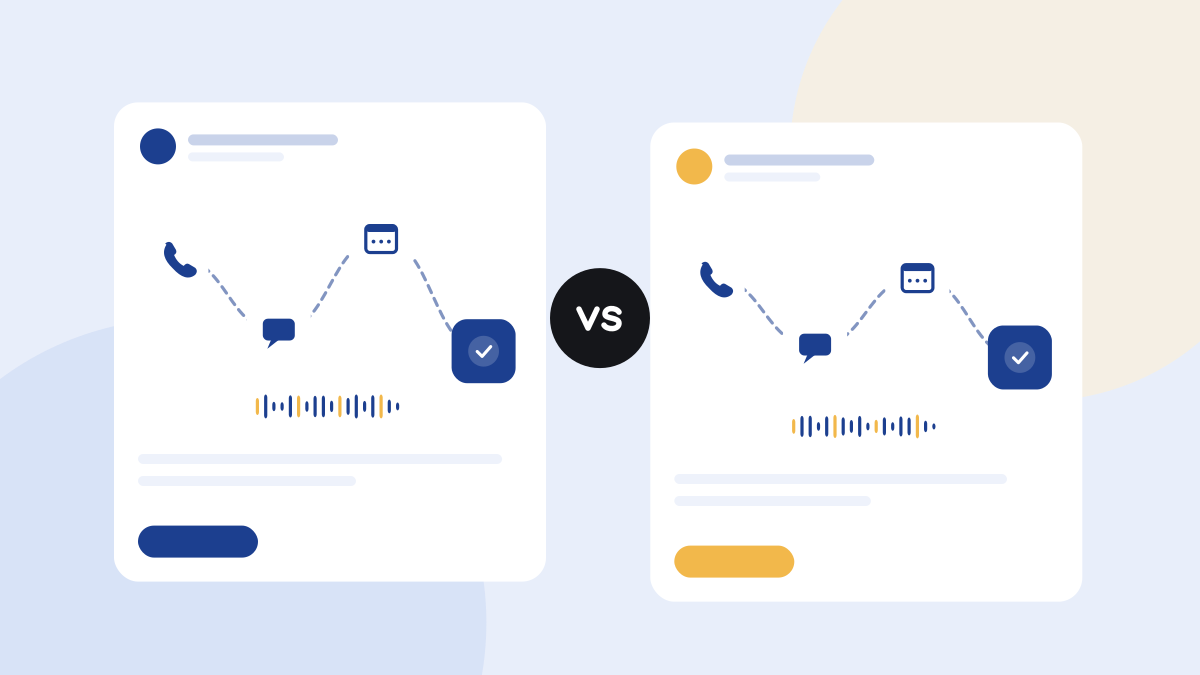
Most of the spa owners we talk to know this, and they are weighing two fixes: a live answering service staffed by people, or an AI voice agent that answers and books on its own. Both are sensible choices. They suit different spas.
Start with a week of your own calls
Begin with your own call log, not a vendor’s demo. Pull a week of calls, listen to a sample, and sort them.
- What do callers want? Booking, rescheduling, prices, hours, parking, questions about a treatment, a concern after a treatment.
- When do they call? During the day while the desk is busy, in the evening, on Saturday afternoons.
- What can be handled without a clinician? Anything about symptoms, reactions, medications or whether a treatment is suitable has to go to a qualified person.
- Where do bookings live? Your scheduling system sets the limits on what either option can do.
A spa whose missed calls are mostly evening bookings has a very different problem from one whose callers want a long conversation about which filler is right for them.
What a live answering service does
A live answering service puts trained people on your line, working from a script and instructions you provide. They greet callers in your spa’s name, answer common questions, take messages and, if you give them access, book into your calendar.
What people do well is judgment and warmth. A person hears hesitation, calms a caller who is anxious, and handles the question nobody wrote into the script. For a first-time client nervous about a needle near their face, a friendly human voice counts for a lot.
What to watch: the people answering usually cover many businesses, so they will not know your treatments the way your own staff does. Quality depends on the script, the training and turnover at the service. Ask in writing how agents are trained on your account, whether they book directly or only take messages, how calls are billed, and what happens during their own busiest hours.
What an AI voice agent does
An AI voice agent answers every call immediately, in natural speech, and on most platforms can hold several conversations at the same time. It works from a brief you write: services, hours, policies, what it may book and what it must hand to a person. Connected to your calendar and CRM, it can book a consultation, send a confirmation text and log the call with a summary.
This became far more practical this year. A voice agent can now be connected to the CRM that holds the calendar and the client records, which for us means GoHighLevel, the platform we build on, so the agent books into the same system the front desk already uses. How that connection works differs by platform and plan, so ask what is included before you build on it.
Its strengths are coverage and consistency: no hold music, no busy signal, the same accurate answer on hours or parking every time, and a written record of every call. What to watch: it has to be kept well away from clinical advice, it needs someone reading transcripts every week for the first couple of months, and some callers simply want a person, so there must always be a quick route to one.
The two approaches compared
| Live answering service | AI voice agent | |
|---|---|---|
| Suits | Spas whose callers need reassurance and nuance | Spas missing routine calls and after-hours bookings |
| What you get | People answering in your name from a script | An agent answering from a brief and booking into your calendar |
| Busy periods | Depends on the service’s staffing that hour | Answers every call at once |
| Records | Messages and notes; ask about recordings | Recordings, transcripts and summaries in your CRM |
| Clinical questions | Routed to your staff | Routed to your staff |
| Privacy | Ask how health details are handled and whether they will sign a business associate agreement | Ask the same of the platform and of whoever builds it |
| Ask before signing | Training, booking access, how calls are billed | Who owns the brief, the handoff rules, who reviews transcripts |
Where each one helps and where it falls short
Live answering service
- Pro: genuine empathy for nervous or upset callers.
- Pro: copes with surprises without anyone rewriting a brief.
- Pro: familiar to clients, who never wonder what they are talking to.
- Con: agents cover many businesses and know yours less deeply.
- Con: quality rises and falls with staffing and turnover at the service.
- Con: bookings may come back as messages your desk still has to return.
AI voice agent
- Pro: answers every call instantly, including several at once.
- Pro: books directly and records every conversation.
- Pro: gives the same answer every time on hours, policies and any prices you choose to share.
- Con: needs a careful brief and regular review to stay accurate.
- Con: some callers prefer a person and will hang up on a machine.
- Con: a wrong answer repeats on every call until someone notices, which is exactly why the weekly review matters.
Matching the phones to the spa
- A single-location spa with a busy desk and lots of evening calls. An AI agent that books consultations after hours and during rushes, handing anything clinical to staff.
- A physician-led aesthetics practice where most calls involve medical questions. A live service, or better still calls routed to trained staff, with AI used only for scheduling.
- A spa with two or three locations. An AI agent for routine calls across all of them, with a clear rule for passing each caller to the right location’s desk.
- A spa that wants both. AI answers first for routine calls, and a live service or the front desk takes the escalations.
A hybrid is often the right answer. The real decision is which one picks up first.
How we build it for med spas
Beyaoshy builds AI voice agents connected to GoHighLevel for med spas, and after working with local businesses since 2015 we treat the agent as part of the practice’s marketing rather than a gadget bolted onto the phone line. The team that runs the spa’s ads, profile, reviews and website also writes the agent’s brief from the spa’s own recorded calls, agrees the handoff rules with the medical director, and reads the transcripts every week until the agent is steady. The phone number, the CRM and every recording belong to the spa from the first day. Reporting counts calls answered and consultations booked, by source, so the owner can see whether the agent is earning its place. The build is the same one other agencies white-label for the med spas on their books.
Before the holiday bookings peak
Decide this month, while there is still time to test before December. Pull the call logs, choose the option that fits your callers, and run it for two weeks with a daily check. To see how we approach AI voice agents for med spas, or to talk it through with us, start on the page for business owners.
Written November 18, 2024, and kept as written. Platforms, features and policies mentioned here are described as they stood at the time.
AI Voice & Chat Agents is part of what we run for clients.
This was written in November 2024, and the platforms have moved on since. We will check where your business stands today and tell you what to do first.