How to judge a marketing agency if you run a tree company
What a tree company owner should ask any agency: license numbers in ads, insurance wording, ISA credentials, Local Services screening and the report.
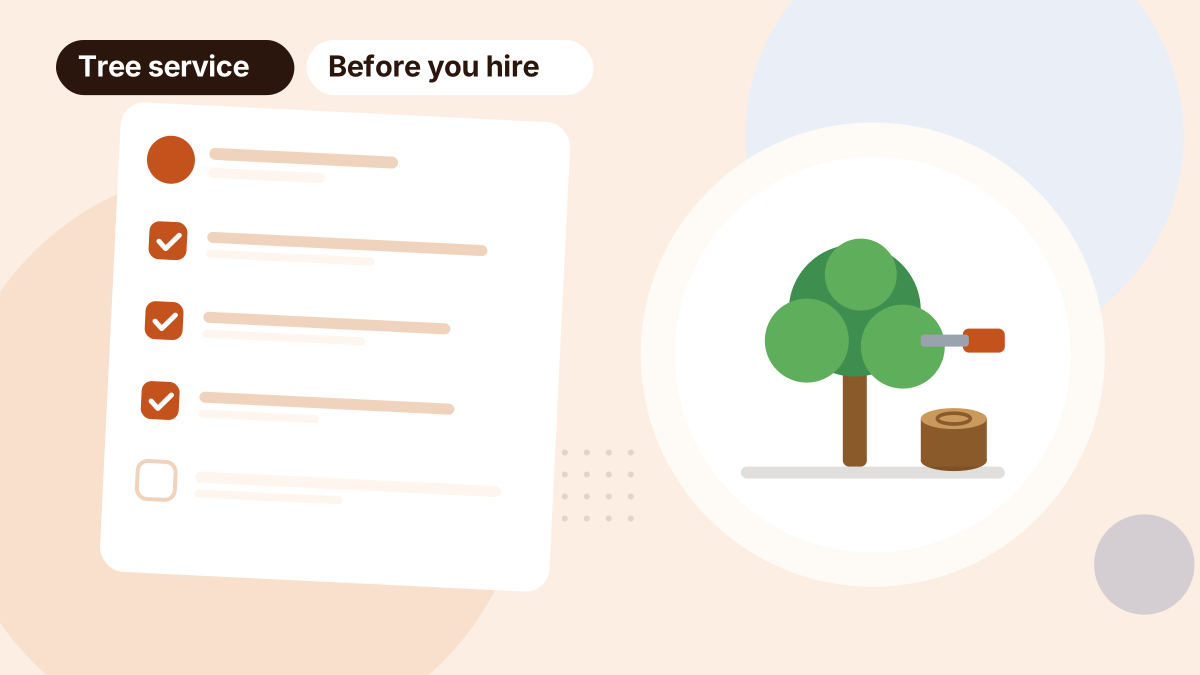
January is when tree company owners have time to sit through a sales call. The crews are busy with dormant-season pruning, the storm calls have eased, and every agency with a home services package knows it. Some of those agencies will do good work. Others will sell you the same template they sell to every trade, and tree work punishes a template faster than most.
The reason is simple. In most home services, the customer’s main worry is whether the company will show up. In tree work, the customer has been told by the industry, by the state and by the federal government to distrust whoever reaches them first. The Tree Care Industry Association’s hiring advice for homeowners says it in so many words: “Don’t just hire someone with a chainsaw who knocks on your door!” An agency that markets you the way the door knocker markets himself is working against you.
The proof problem that shapes tree marketing
Look at what homeowners are told to check before they let anyone climb:
- Insurance. TCIA tells them to ask to see current certificates of liability and workers’ compensation insurance.
- Licensing. TCIA tells them to check with city hall, since many communities license arborists. The FTC tells storm victims to confirm a contractor’s license with the state or county and to ask for proof of insurance.
- Payment and paperwork. TCIA says not to pay in advance, to get estimates in writing and to insist on a written work order. The FTC is blunter: if they want cash up front, walk away.
- Fake credentials. Last May, Maryland’s Department of Natural Resources warned residents about unlicensed operators displaying fraudulent license numbers on company vehicles or claiming to be “bonded and insured.”
Every item on that list is something your marketing can show or fail to show. So the first test of an agency is whether it starts with proof or starts with ad spend.
Questions to ask in the first meeting
“Where will my license number appear?” In Maryland the answer has to be “everywhere.” The state requires anyone who advertises or performs tree care for hire to hold a Tree Expert License, and requires every licensee to display the number on trucks, proposals, contracts and advertisements. A first offense is a misdemeanor with a fine of up to $500. New Jersey requires at least one licensed person in each tree care company, sets minimum liability insurance and has rules on how licensees advertise. In California, tree contractors have had their own C-49 Tree and Palm classification since January 1, 2024, and since January 1, 2025 unlicensed operators working under the $1,000 minor-work exemption carry an advertising disclosure. An agency that has not asked which state you work in has not read any of this.
“How will you describe our insurance?” “Fully insured” on its own reads exactly like the “bonded and insured” line Maryland warns about. A better agency will name the coverage, liability and workers’ compensation, and put a line on the site and the estimate offering the certificate on request.
“What will you do with our credentials?” An ISA Certified Arborist has documented at least three years of full-time arboriculture experience, with ISA counting a year as roughly 1,795 hours of work, or a mix of education and practice. ISA’s Find an Arborist directory lets the public verify the credential. TCIA Accreditation is a third-party check of insurance and business and pesticide licenses that runs for three years with yearly check-ups, and accredited companies get decals for trucks and helmets and a logo for marketing. The right answer links each credential to the place a buyer can check it.
“Will you set up Local Services Ads, and what does Google check?” Google lists Tree services as its own category, and since October those ads carry the single Google Verified badge. Screening asks tree companies for general and professional liability insurance, state business and owner licenses where the law requires them, and background checks for some advertisers, and Google puts the average at three to four weeks after documents are in. Anyone promising your ads will be live next week has not been through it.
“What happens to storm calls from outside our area?” Google no longer credits Local Services leads for areas or job types a business does not serve. A storm in the next county can fill your phone with leads you pay for and cannot reach. Ask how the agency sets and changes your service area when the weather turns.
What the first ninety days should look like
A plan worth signing puts proof before traffic:
- Weeks 1 to 2. License numbers, insurance wording and credential links added to the site, the Business Profile, every ad and the estimate template.
- Weeks 1 to 4. The Local Services application filed, profile categories and services corrected, and separate pages for emergency removal, pruning, stump grinding and plant health care.
- Weeks 3 to 6. Call tracking on every channel, with each lead marked as emergency or planned work.
- Weeks 5 to 12. Search campaigns on removal and pruning terms, a review request after every job and reminders to past customers about the next dormant season.
If a proposal starts with a budget for ads and gets to the license number in month three, it has the order backwards.
What a monthly report should show
A tree company’s report should follow the call all the way to the sold job:
- Calls answered and calls missed. CallRail’s January 2025 analysis put the missed call rate for home services at 14%. In storm weeks that is where the money goes.
- Estimates and sold jobs by source, split into emergency and planned work, because a storm week and a pruning month should never be averaged together.
- Cost per sold job against job value. Thumbtack’s tree removal guide, updated on January 6, puts the national average for removing one tree at $450 to $1,450. Across the 16 home service categories in LocaliQ’s 2025 benchmarks, the median search ad cost per lead was $90.92 for April 2024 to March 2025. There is no separate tree category, so judge your own numbers against your own tickets.
- Reviews added, and how many of them mention the crew or the cleanup.
What to do this month
- List every state and city license you hold, and check each ad, listing, truck and proposal against your state’s display rule.
- Ask each agency you meet for sample tree service ads, and look for a license number and an insurance line in them.
- Gather current certificates of liability and workers’ compensation insurance so they are ready to send with estimates and to Google.
- Collect the directory links for any ISA certification or TCIA accreditation on your team.
- Start the Local Services Ads application now, so screening is finished before spring storms.
- Ask every agency for a sample report that shows sold jobs, not just leads.
An agency that answers these questions without hedging is worth a second meeting. Our page for tree service companies shows the plan we would run, our Google Ads and Local Services work covers the paid side, and our website builds cover where the proof lives.
Written January 13, 2026, and kept as written. Platforms, features and policies mentioned here are described as they stood at the time.

The team that wrote this runs marketing for home service companies.
This is recent. How it applies to you depends on your market, so we will check where your business stands today and tell you what to do first.