Skip to content

Tree service marketing for insured crews up against the chainsaw at the door

After a storm, the homeowner with a limb through the porch calls whoever answers first, and a crew with a trailer and no paperwork is often already knocking. TCIA tells that homeowner to ask for liability and workers' compensation certificates, and Maryland makes licensed tree experts print the license number on every ad. We put your proof where buyers check, win the map and Local Services Ads inside the area you can reach, and fill the weeks between storms with dormant-season pruning.

Taking on new tree service companies now

Reviewed by Niomi Ascot on

Three ad habits that make a licensed tree company look like the storm crew

Leaving the tree expert license number off the ad

Maryland requires anyone who advertises or performs tree care for hire, removal included, to hold a Tree Expert License, and every licensee must show the number on trucks, proposals, contracts and advertisements. A first offense is a misdemeanor with a fine of up to $500. New Jersey requires a licensed person in every tree care company, and California has tested tree contractors under its own C-49 classification since January 1, 2024. The number belongs in the wording of every ad, on the Business Profile, at the foot of each web page and on the estimate form, as well as on the truck door.

Telling homeowners the insurance will pay

Triple-I says a homeowners policy generally pays about $500 to $1,000 to remove a tree that hits an insured structure, usually nothing for debris when it hit nothing insured, and nothing for damage traced to poor maintenance. An ad that says "insurance covers it" turns a finished removal into an argument when the check is smaller than the bill. Explain how coverage usually works, offer photos and an itemized estimate for the claim, and leave the promises to the insurer.

Selling the way storm chasers sell

Door hangers offering same-day work for cash look like what the FTC tells storm victims to walk away from: contractors who say they need no license, want everything paid up front, or ask for a wire transfer, gift card, payment app, cryptocurrency or cash. Maryland's Department of Natural Resources adds fake license numbers on vehicles and loose "bonded and insured" claims to that list. Advertise the opposite in plain words: a written estimate and work order, no payment before the work, certificates sent on request.

Pruning sells in the dormant months, and hurricanes take over the fall

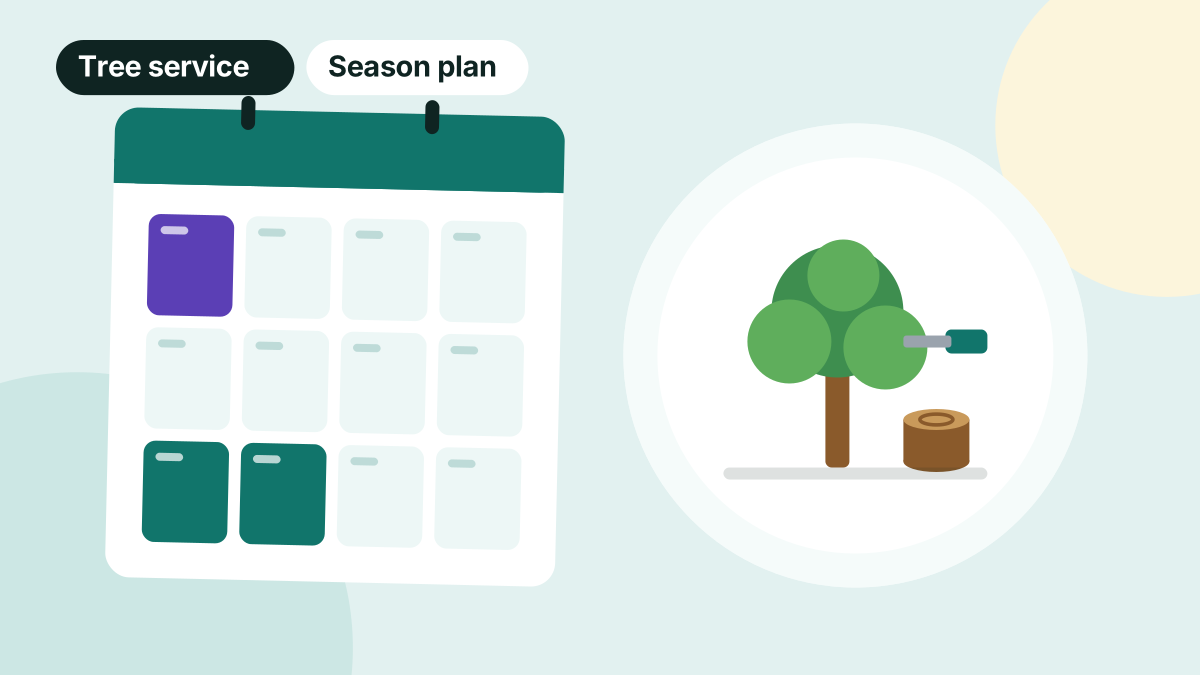
The marks show how a residential tree company's year usually runs, in our experience. The dates in the notes come from ISA, the Texas A&M Forest Service and the National Hurricane Center. A Gulf Coast crew and a crew near the Great Lakes live different years, so each note says where it applies.

Demand through the year for tree service companies
  1. January: Busy
  2. February: Busy
  3. March: Steady
  4. April: Busy
  5. May: Busy
  6. June: Busy
  7. July: Steady
  8. August: Busy
  9. September: Peak
  10. October: Busy
  11. November: Steady
  12. December: Steady
December
Planned work slows over the holidays, which makes it the month to mail pruning offers to past customers and file a Local Services Ads application: Google's own estimate for screening is three to four weeks after the paperwork goes in, which puts a December filing on the page by the time dormant pruning peaks.
January and February
Dormant-season pruning. ISA says growth and wound closure are maximized when pruning takes place before the spring growth flush, which gives every crew a reason to call past customers now. In the North, ice storms add emergency removals in the same weeks.
February through June, central Texas
The Texas A&M Forest Service advises against pruning or wounding oaks from February through June to slow oak wilt, which kills trees across 76 Texas counties. Book oak work into January, pause oak trimming ads in spring and sell removals and other species instead.
April and May
Leaf-out is when dead limbs become obvious, and spring storms start bringing them down. ISA warns against heavy pruning of live tissue just after the spring flush, so spring ads should lead with risk checks and dead-wood removal rather than large crown reductions.
Hurricane season, Gulf and Atlantic coasts
The National Hurricane Center dates the Atlantic season June 1 to November 30. Its climatology has the season's first hurricane arriving, on average, in the first half of August, and the first major hurricane around the turn of August into September. Write the storm-week rules for budget, service area and phone coverage by June.

Where tree jobs come from, and the proof each one asks for

Ranked by how much residential work each usually brings a tree company. Proof turns up in nearly every one, because TCIA, the FTC and state foresters all tell homeowners to check licenses and insurance before anyone starts a saw.

Google Search and the map pack

Storm searches happen on a phone, often with a trunk across the driveway, and the company that shows recent reviews and open hours, then answers, gets the job. Whitespark's 2026 survey of local search specialists ranks being open at the time of the search near the top of map factors, and BrightLocal found 32% of consumers look for reviews from the last two weeks.

Local Services Ads under Tree services

Google's Tree services category covers companies that plant, remove and maintain trees, and it carries the Google Verified badge. Google wants proof of general and professional liability cover, and checks the state business and owner license wherever local law calls for one. Average response time is one of the ranking inputs, which makes the phone part of the ad.

Neighbors and the street you are working on

TCIA's hiring advice starts with asking neighbors, friends or business associates for a name. A bucket truck parked on a street for a day is seen by every house on it; a yard sign, a card left at the neighbors' doors and a review request that evening turn that attention into the next estimates.

Arborist and accreditation directories

ISA runs Find an Arborist so the public can verify ISA-credentialed professionals, TCIA offers an accredited company search, and Maryland's forest service lets residents look up licensed tree experts. Careful buyers check there, so each listing should match your business name and phone exactly, and your site should link to it.

Thumbtack and other lead sites

Thumbtack publishes national price guides for removal and trimming, so its shoppers often arrive with a figure in mind, around $450 to $1,450 to take down one tree. Useful for filling trimming and stump days, as long as the tracking shows those jobs closing at your prices.

HOA, municipal and utility contracts

A contract channel rather than a consumer one: bids, references and insurance certificates win it, not ads. TCIA promotes accredited companies to municipalities and communities, which is one more reason to hold the credential and to show it.

Paying Google per lead, paying a marketplace, or earning the call yourself

Three ways a tree company gets a homeowner's call. Most run two at once; the cells come from each one's own rules and pages, and the right mix depends on how much storm work you want to take.

QuestionLocal Services Ads (Tree services)Thumbtack and similar lead sitesYour website and Google profile
Screening before your first leadProof of general and professional liability cover, the state license where local law calls for one, and for some advertisers a business and owner background check; three to four weeks on averageThe marketplace's own sign-up and checksNothing by default, which is why your license number, certificates and credentials must be shown by you
Storm calls from outside your areaIf charged, not credited: Google no longer credits leads for areas or job types you do not serveHandled under the site's own terms; read them before storm seasonShaped by the service areas and pages you publish
What a lead isCalls, messages and bookings, with a message lead normally costing less than a call in Google's pricingRequests and messages inside the siteCalls, forms and direction requests that belong to you
How credentials showThe Google Verified badgeYour profile and reviews on that siteLicense number, ISA certification linked to Find an Arborist, TCIA accreditation logo
What you are compared withRating, review count and how fast you respondThumbtack's national price guide and the other quotesPhotos of your own crews and equipment, and your written-estimate policy
Best at"Tree removal near me" in storm weeks, if someone picks upTrimming and stump jobs from price shoppersPlanned pruning, plant health care and buyers who check credentials first

Google started shifting Local Services accounts into Google Ads in August 2026, and tree services was absent from that opening group. Google's schedule puts service-area businesses with no storefront, the way most tree companies are set up, in a late 2026 wave, and anything still left over in 2027. Accounts that move keep pay per lead and the badge but lose manual max-per-lead bidding.

Storm weeks and slow quotes: where a tree company's paid calls go missing

Tree work arrives in two shapes: the storm call that has to be answered tonight and the removal or pruning quote a homeowner takes a week to decide. Each one leaks in its own way.

Storm calls that ring out

Invoca's July 2026 benchmarks put the answer rate for its Lawn & Trees group, which takes in tree companies, at 54% of calls. On a normal week that is a problem; on the morning after a storm, the person with a limb on the roof simply dials the next name on the list, and the crew with a trailer and no paperwork picks up.

The fix. Set up overflow before the season: a forwarding rule to a second phone, an answering service, or an AI agent that says plainly it is automated and takes the address, photos and whether anything is on a roof or a wire. Tell callers that anything touching a power line is the utility's job first. Call every storm lead back within the hour, worst damage first.

A full calendar that sends callers away empty-handed

After a big storm a tree company can be booked for weeks, and "we're booked, sorry" sends the caller straight to whoever is knocking on doors down the street. In our experience, a caller who gets a real date and a clear interim step usually waits for the crew they trust.

The fix. Script the full-calendar call: "We're booked through the 20th. I can put you at the top of the cancellation list and text you the moment a crew frees up, and until then, keep everyone out of the room under that limb." Log each turned-away job with its address, so the estimator can quote it once the rush eases.

Removal quotes nobody keeps count of

Jobber's owner survey from December 2025, which included tree care companies, found more than a third of respondents closing over 70% of what they quote, while 21% of starting businesses won under 30% and plenty tracked nothing at all. Planned removals and pruning are where an untracked quote quietly turns into another company's job.

The fix. Text the quote the day of the visit with a photo of the tree marked up to show what comes down. Call on day two to settle stump grinding and cleanup, send your next open week on day ten, and close the quote on day twenty-one with a lost reason picked from a short list.

Reviews that arrive in bursts, then stop

Storm weeks bring a rush of jobs and, if anyone asks, a rush of reviews, followed by months of nothing. In BrightLocal's 2026 survey, 74% of consumers looked for reviews from the last three months, and the experts in Whitespark's 2026 survey ranked a steady flow of reviews over time 14th of 187 map factors.

The fix. Send the same review request to every customer the evening a job finishes, pruning and stump work included, so the flow keeps going between storms. Google's policy bars asking only happy customers, offering anything in return and asking for reviews that name a staff member, so the request names the company and nothing else.

Proof and the map first, storm-week numbers next, repeat pruning last

Being found usually comes first in a home service plan. A tree company needs being chosen in the same breath, because homeowners are told by TCIA, the FTC and state foresters to check credentials before anyone climbs, and the first storm tests both at once.

Chosen

Being the one they pick once they have found a few.

License number, named insurance coverage, ISA certification and TCIA accreditation, plus photos of your own crews, go on the site and profile before a dollar goes to ads. They are exactly what homeowners are told to ask for, and exactly what a storm crew cannot show.

Found

Being the company that shows up when someone searches.

Business Profile categories and storm hours set, a Local Services Ads application under Tree services filed early because screening runs three to four weeks, and separate pages for emergency removal, pruning, stump grinding and plant health care so each search lands on the right one.

Clear

Knowing which work produced which jobs.

Every call tagged by channel and as emergency or planned work. One storm week can swamp a month of averages, so spend is watched by the day while a storm is on and cut as soon as calls start arriving from towns you cannot reach.

Kept

Turning one job into the next one and the referral.

Dormant-season pruning reminders to past customers, yearly inspection offers for the big trees you have already worked on, and a referral ask after any job the street can see.

Weeks 1 to 2

License, insurance and credentials go on everything. Your state license number where one applies (the LTE number in Maryland), a coverage line naming liability and workers' compensation, and ISA certification linked to the public directory, on the site, the profile and the estimate template.

Weeks 1 to 4

Local Services Ads application filed under Tree services. Profile categories, services and storm hours set while Google screens the account, and service pages written for removal, pruning, stump grinding and plant health care.

Weeks 3 to 6

Call tracking live on every channel. Each lead tagged emergency or planned, with a daily view for storm weeks and a written rule for when spend goes up and when it stops.

Weeks 5 to 12

Search campaigns on removal and pruning terms. Oak pruning held back in the oak wilt months in Texas, out-of-area storm searches excluded, and a review request sent the evening each job finishes.

From week 8

Repeat work set to run on its own. Dormant-season pruning reminders, inspection offers to past customers and a note to the neighbors after visible jobs.

What one tree is worth, what insurance pays toward it and who picks up

Published figures for tree work and the categories nearest to it. They describe the market, not our results. No ad benchmark breaks out tree companies, so the lead cost below is the median across every home service category LocaliQ tracks, and the call figures come from Invoca's Lawn & Trees group, which pools tree and lawn businesses that use its call tracking.

$450 to $1,450
National average for removing one tree in Thumbtack's data, inside a low-to-high range of $373 to $3,300
Thumbtack cost guide, updated January 2026
$500 to $1,000
What a homeowners policy generally pays toward removing a tree that hits an insured structure; usually nothing for debris otherwise
Triple-I
$90.92
Median Google search cost per lead across the 16 home service categories LocaliQ tracks, April 2024 to March 2025; none of them is tree work
LocaliQ home services benchmarks, 2025
32%
Of consumers look for reviews written in the last two weeks, up from 20% a year earlier
BrightLocal, 2026
Calls answered by a person, by home services group
  • Plumbing74%
  • Pest Control73%
  • Lawn & Trees54%
  • All home services groups52%
  • HVAC34%

Tree and lawn businesses answer just over half their calls, yet in the same report half of their answered calls were sales leads, the highest share of the nine groups Invoca charted. The calls are worth more than the answer rate suggests. Source: Invoca, 2026.

For a tree company with one to three crews and an owner who still bids the jobs, our plans are affordable. We scope them around your storm exposure, your license situation and the planned pruning you want more of rather than selling a package, and the free plan sets out the first steps in writing before you pay us anything.

Get your free plan

The tree companies we fit best already hold the paperwork a storm crew lacks

There is no national license for tree work, so the companies below are defined by what they can prove: a state license where one is required, insurance they can document, and often an ISA Certified Arborist on staff.

The one- to five-crew company with a certified arborist

ISA certification takes at least three years of full-time arboriculture experience, or a mix of education and practice, and the credential can be checked in ISA's public directory. If you have one on staff and want more pruning and removals booked weeks ahead, that is the first story to tell.

The accredited firm, or one working toward it

TCIA Accreditation is a third-party check that includes insurance, business and pesticide licenses, valid for three years with yearly check-ups, and it comes with truck and helmet decals and a logo for marketing. We put it where buyers look: the profile, the estimate, the ads.

The Gulf or Atlantic coast company that lives by hurricane season

Between June 1 and November 30 a single storm can bring more calls than a planned month. You need to scale up fast inside the area you can serve, and stop paying for calls from towns you cannot reach, since Google does not credit those leads.

The plant health care or consulting practice

Treatments, risk assessments and permit help sell on expertise rather than speed. In cities like Austin, where removing a protected tree of 19 inches or more needs a permit, a page that explains the process brings in buyers who plan ahead.

Who we would point elsewhere. Unlicensed operators in states that require a license, such as Maryland, New Jersey, or California above the $1,000 minor-work limit: the license comes first, and Local Services screening checks it where the law requires one. Out-of-state storm crews that want to look local: state rules and Google's screening both work against that, and so would we. And a company that cannot pick up during a storm: more leads would mostly turn into bad reviews.

Who licenses tree work, and where the license number has to show

There is no national license for tree care, and no federal safety standard written for it either. What a tree company must hold, and what its advertising must say, depends on the state and sometimes the city, and most of the rules were written in answer to complaints after storms.

Maryland. The tree expert law dates to 1945. Anyone who advertises or performs tree care for hire, removal included, needs a Tree Expert License, and every licensee must display the number on trucks, proposals, contracts and advertisements. A first offense is a misdemeanor with a fine of up to $500. After storms, the Department of Natural Resources warns residents about operators painting fraudulent license numbers on vehicles or calling themselves “bonded and insured”, and points them to its license search.

New Jersey. The Tree Expert and Tree Care Operators Licensing Act requires at least one licensed person in every company that hires itself out for tree care, sets minimum liability insurance, and includes rules on advertising properly. The state board says the act exists to address complaints about unqualified, uninsured or dishonest companies, especially after storms.

California. Since January 1, 2024, tree contractors can be licensed under the C-49 Tree and Palm classification, and every applicant sits a trade exam, because the state wanted tree contractors tested on health and safety. Holders of the older classifications may keep working under them, and incidental pruning by a gardener falls outside the C-49. From January 1, 2025 the minor-work exemption is $1,000, and unlicensed operators relying on it carry an advertising disclosure.

Cities. TCIA tells homeowners to ask city hall whether arborists need a local license, since many communities require one. Austin regulates trees from 8 inches in diameter on private property, requires a permit to remove a protected tree of 19 inches or more, and treats listed species from 24 inches as heritage trees.

Safety. OSHA still has no tree care standard. In June 2026 TCIA reported that OSHA’s construction advisory committee had unanimously recommended writing one, and that OSHA frequently relies on ANSI Z133, now in its 2026 edition.

For the marketing, that comes down to three habits. Put the license number wherever your state wants it, which in Maryland means every ad. Say who on the crew holds which credential, and link the directory that proves it. And keep every claim to something a buyer can check, because the state is telling the buyer to check.
A free plan for your tree company, from license lines to a storm-hour test call

Any tree company that asks gets three things at no cost: a consult, a frank assessment of the company's position, and a written plan the owner keeps whether we are hired or not. For a tree company, the plan covers:

Get your free plan
  • Where you appear for "tree removal near me", "emergency tree service" and "tree trimming" in your towns, and whose names fill the map results and the Local Services slots above them today.
  • Every ad, listing, page and proposal template checked for the license number your state asks for, from Maryland's LTE number to New Jersey's licensed-operator rule.
  • How your insurance and credentials read to a cautious buyer: named coverage, a certificate offer, ISA certification linked to the directory and any TCIA accreditation.
  • Your reviews: how many, how recent and how they are answered, set beside two or three tree companies you bid against.
  • A test call while the crews are out, and what happens today to a storm call from a town you do not serve.
  • A ninety-day sequence built around your dormant pruning weeks and the months storms usually reach you.

Questions tree company owners bring to the first call

Can you get my phone ringing when a storm comes through?

Yes, inside the area you can serve. Local Services Ads and search budgets can be raised within a day of a storm, and Local Services ranks partly on average response time, so the plan covers who answers as well as the ads. Google no longer credits leads from areas you do not serve, so storm calls from beyond your map are a cost, not a bonus.

Is Local Services Ads worth it for a tree company?

Usually, if a person answers live. The category is Tree services, and since October 2025 it carries the single Google Verified badge. Expect Google to ask for proof of general and professional liability cover and any state license your work needs, and to take three to four weeks on average. Message leads normally cost less than calls, which suits the homeowner who texts a photo of a split trunk. How we pair Local Services Ads with search campaigns.

Maryland wants my license number on my ads. Will you handle that?

Yes, on every ad, listing, page and proposal template. Maryland requires licensed tree experts to display the number on trucks, proposals, contracts and advertisements, and the state warns residents about vans showing fake ones. New Jersey licensees have rules on advertising properly too. Before any ad goes live, we read your state's rule.

Should I advertise that I am ISA certified or TCIA accredited?

Yes, and link the public directories so a buyer can check in one tap. ISA's Find an Arborist exists to let the public verify ISA-credentialed professionals, and TCIA's site has an accredited company search. Accredited companies also receive truck and helmet decals and a logo for their marketing. How we build credentials into a site.

How do I stand apart from storm chasers without sounding like one?

Say plainly what they will not: a written estimate and work order, no payment before the work, certificates of liability and workers' compensation on request, and your license number in view. TCIA tells homeowners not to pay in advance, and the FTC tells them to walk away from anyone who wants cash up front.

Can I tell customers their insurance will pay for removal?

No. Describe what policies typically do instead. Triple-I says removal is generally covered up to about $500 to $1,000 when a tree hits an insured structure, that there is generally no debris coverage when it hits nothing insured, and that poor maintenance is not covered. Some insurers will pay to clear a tree blocking a driveway.

When should a tree company spend the most on ads?

In two windows: dormant-season pruning in January and February, and storm season, which on the Gulf and Atlantic coasts runs from June 1 to November 30. In central Texas, oak pruning pauses from February through June on the Texas A&M Forest Service's advice, so oak campaigns move to the other months.

Do my pages need to mention tree permits?

Where your cities require them, yes. Austin requires a permit to remove a protected tree, 19 inches or more in diameter measured at 4.5 feet, and treats listed species from 24 inches as heritage trees. A page that says who applies for the permit and how long it takes answers the question buyers are nervous about.

Can you help me win HOA, municipal or utility contracts?

Partly. Those are won on bids, references and insurance certificates rather than ads, so we build the proof pages and the profile a board will check, and keep ad money on homeowners. TCIA promotes accredited companies to municipalities, which makes accreditation worth showing.

How will I know which jobs came from ads?

Call tracking on every channel plus a job-source field in your estimating or CRM software, so each signed job carries its source. We report emergency and planned work separately, because a storm week and a pruning month should never share one cost per job. How we tie calls to jobs in the CRM.

Find out who gets the call when the next storm drops a tree in your town

Send us the company name, the towns your crews reach, any state license you hold and a rough split between storm calls and planned pruning. You get back where you rank for removal and trimming searches in those towns, how your license, insurance and credentials read to a careful buyer, what a storm call from outside your area costs you today, and what we would change first, ahead of your next dormant season or storm month.

  • A free consult. A real conversation about your business, your area and what is not working yet.
  • An honest evaluation. Where you stand in search, ads and follow-up next to the businesses you lose customers to.
  • A plan you keep. What we would fix first and why. It is yours whether or not you work with us.

Form not loading? Email hello@beyaoshy.com and we will reply within one business day.

Sources

The figures on this page come from these published sources, checked on October 3, 2026. Benchmarks are averages across many advertisers; your market will differ, which is what the free plan is for.

Agencies with tree service companies among their clients: see the partner model.