Skip to content

Restoration marketing for the night the water comes in, and the rebuild after it

The EPA tells homeowners to dry water-damaged areas within 24 to 48 hours to prevent mold, so the person standing in a wet hallway calls whoever answers first. After that call, an adjuster, a carrier program or a third-party administrator has a say in who is paid and how much. We make your company the one that shows up in the search and picks up the phone, keep your claim and mold wording inside state law, and help you hold on to the rebuild once the drying is done.

Taking on new water, fire and mold restoration companies now

Reviewed by Niomi Ascot on

Who a homeowner calls with water on the floor, and who else gets a vote

Listed from the source that usually sends a restoration company the most work to the one that sends the least. The order is our judgment from running these accounts, and every number below names its publisher. Two of the six are people rather than ad products, since insurers and the trades who reach a leak first steer this work unusually hard.

Google search and the map pack

"Water damage restoration near me" gets typed on a phone in the middle of the loss. The EPA's advice to dry wet areas within 24 to 48 hours is why that caller rarely compares five websites. A Business Profile can list up to 20 service areas, so a company covers its metro with service areas and town pages, not extra listings.

Local Services Ads, under Water damage services

Google describes the category as professionals who clean and inspect water damage, including mold and sewage, and names IICRC certification as a requirement, alongside certificates for liability and professional insurance and a state license wherever one applies to the job. The ad carries the Google Verified badge. Fire and smoke restoration is not named in any category.

Carrier programs, TPAs and managed-repair networks

Insurers route a share of losses through preferred-vendor lists and networks. Contractor Connection, for one, says it handles 500k assignments a year through 5,000 general and specialty contractors, with water mitigation and odor removal among its residential services. The volume is real, and so are the program pricing and estimate reviews that come with it.

Referral partners who reach the leak first

The IICRC S500 standard leaves finding and correcting the source of the water to the property owner, not the restorer, so a plumber is often first through the door. Property managers, HOA boards and adjusters bring repeat losses. These relationships run on a follow-up routine and a fast answer, not on ad spend.

Search ads for the losses the badge does not cover

Burst pipe, sewage backup, smoke damage and mold removal, by town. Restoration is not on Google's US advanced-verification list, which names only locksmith and garage door services, but text ads promoting emergency or repair services may not carry discounts or coupons.

Review sites, Facebook and AI assistants

BrightLocal's 2026 survey found the average consumer checks six review sites, and the share asking ChatGPT or another AI tool to recommend a local business climbed from 6% the year before to 45%. These rarely win the 2 a.m. water call, but they help decide mold and rebuild jobs, where the homeowner has a day to read.

The midnight call, the signature at the door and the rebuild nobody chased

A restoration company pays for the emergency call through Local Services Ads, the map pack and referral partners. A share of those jobs is then lost in the first minutes of the call, in the paperwork signed at the door, and in the weeks before anyone awards the rebuild.

Half the emergency calls reach no one

Invoca's July 2026 home services report has 51% of restoration calls reaching a person (vendor data, averaged across its customers), so roughly one caller in two gets no one. Someone watching water spread across the floor does not wait for a callback. They dial the next listing.

The fix. Send any call not picked up by the third ring to an on-call technician or a live answering service. If an automated agent covers nights, its first sentence should say it is an automated assistant for your company; Maine requires that disclosure outright, so check your states with counsel. And since October 1, 2026, Google charges Local Services Ads for a missed call in your stated hours once the caller holds past 20 seconds, with a few exceptions, so set the ad hours to the hours a person really answers.

We answered, but never got a name or a time

Across the nine home service trades in Invoca's July 2026 benchmarks, restoration among them, the caller's details were taken on 62% of phone leads, and staff asked for the booking on just 45%. A homeowner whose phone dies in a flooded basement, or who hangs up to deal with the water, cannot be called back if nobody wrote the number down.

The fix. Train the opening minute in a fixed order: name and callback number first, then "Is water still coming in, and do you know where the main shutoff is?" Then offer the dispatch as a question, "I can have a technician at your door around 10:30 tonight. Shall I send them?", and read back the address and arrival time before the call ends.

They called us for drying, and we sold the rebuild on the same visit

The FTC's Cooling-Off Rule leaves out repairs a homeowner asked you to come and do, but extra goods or services sold during that visit are covered. Its emergency exception is narrow: the buyer must have made the first contact and must give you a separate statement, in their own handwriting, signed and dated, that describes the emergency and waives the right to cancel. A preprinted waiver box on your work authorization is not that statement.

The fix. Keep two paper paths. The mitigation the homeowner called about goes on the work authorization. A reconstruction contract or upgrades they did not call about go on a dated contract, with two copies of the cancellation notice showing your company name, address and the date, and the right to cancel explained out loud. This is not legal advice; have counsel review your forms for each state you work in.

The rebuild estimate went out and nobody called

ServiceTitan's 2026 Roofing and Exterior Market Report, a vendor-commissioned survey of more than 1,000 firms that skews toward large ones and includes restoration work, found only 16% follow up on unsold estimates the same day. Reconstruction is often awarded weeks after the loss, once the adjuster's scope is back, and in our experience it goes to whoever stayed in touch through that wait.

The fix. Text the homeowner the day the estimate goes out, with the scope in their words and where the claim stands. After that, time each contact to the claim rather than the calendar: ask when the adjuster expects to inspect and call the day after, revise the estimate to the approved scope the day it arrives, and if the claim stalls, send drying photos or a finished rebuild nearby so the homeowner remembers who came out that night. Close the file only when the homeowner says the work went elsewhere.

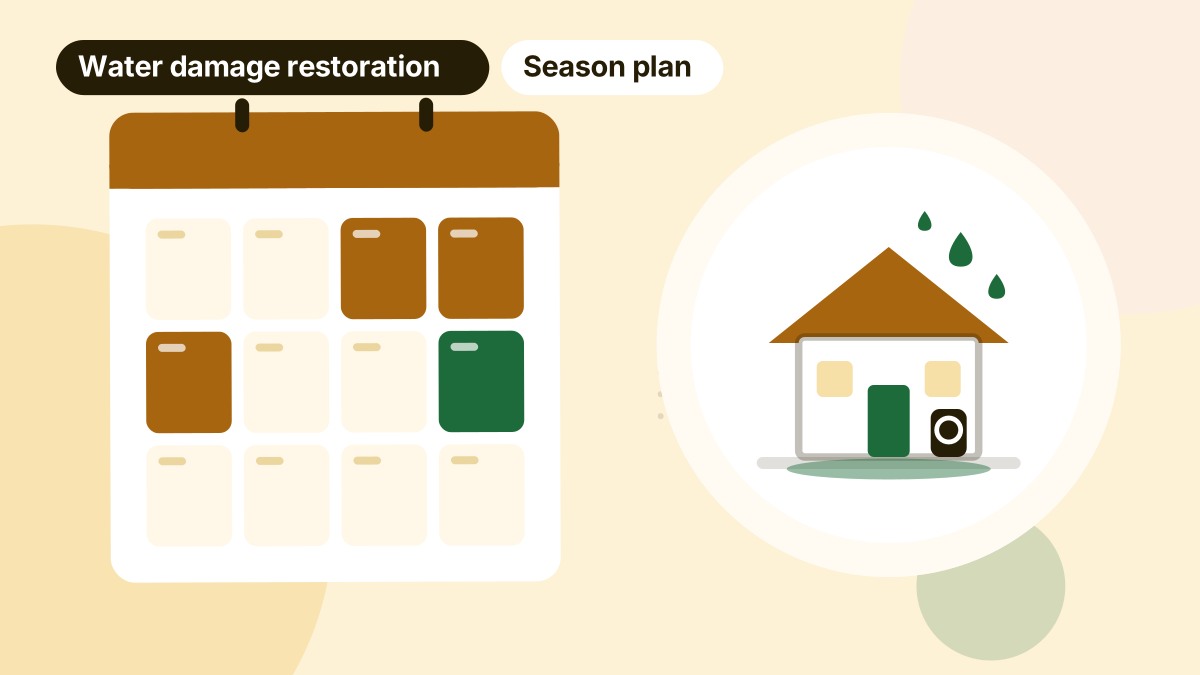
A restoration year has two peaks: the first hard freeze and the September storms

Nobody publishes month-by-month restoration demand, so the ratings show our experience across the country; the drivers behind them are sourced. Northern companies peak with the freeze. On the Gulf and Atlantic coasts a second peak arrives with hurricane season, and there it is often the larger one.

Demand through the year for water, fire and mold restoration companies
  1. January: Peak
  2. February: Peak
  3. March: Busy
  4. April: Busy
  5. May: Steady
  6. June: Busy
  7. July: Busy
  8. August: Busy
  9. September: Peak
  10. October: Busy
  11. November: Steady
  12. December: Busy
December to February
Frozen pipes. From August 2022 to August 2023, State Farm paid over $806 million on more than 32,000 frozen pipe and water damage claims, and its biggest state was Georgia at $100 million, ahead of Illinois, Tennessee and Texas. A southern company needs the winter page and the night cover ready as surely as a northern one.
Holiday weeks
Homes sit empty over Christmas and New Year just as the hard freezes arrive, and in our experience those losses are often found days later by a neighbor or a returning owner. Keep the ads on and the on-call rotation staffed through the holidays, when competitors trim both.
Before June 1
Atlantic hurricanes are officially in season from June 1 through November 30, NOAA's National Hurricane Center says, and its eastern Pacific season starts May 15. Local Services Ads screening, which Google says averages three to four weeks, means applications and storm pages belong in April, not June.
Mid-August to mid-October
NHC climatology has the season's first hurricane usually arriving in early to mid-August, the bulk of activity between mid-August and mid-October, and the Atlantic peak on September 10. Coastal companies set catastrophe staffing and budgets before August, not during the first named storm.
November
Hurricane season ends November 30 and heating season begins, which in our experience brings furnace puff-backs and the first smoke and soot calls of the winter. Pages for smoke cleanup should be live before the first cold week.

Restoration companies with a staffed base, certified techs and someone on call every night

Google lists IICRC certification among its requirements for water damage advertisers, and a rented address where nobody works is not eligible for a Business Profile. Every company below already clears both bars, or is close.

The independent mitigation shop running one to three trucks
IICRC-certified, on call around the clock, and tired of working to someone else's rate sheet. A direct water job carries your own estimate, so the map pack for "water damage restoration", Local Services Ads and a short list of referral partners usually move first.
The franchise territory allowed to market itself locally
The brand's national advertising brings the name. The territory's Business Profile, reviews and call tracking decide who in the metro gets the call. We build that local layer and report it apart from what the brand sends, so the owner can see which source paid for the trucks.
The mitigation firm that watches the rebuild go to someone else
You extract and dry, then the homeowner or the adjuster hands reconstruction to another contractor. Follow-up while the dehumidifiers are still running, drying logs and photos the homeowner can see, and a review ask at handover give you a fair shot at the second job on the same claim.
The Texas or Florida company with mold licenses on staff
Florida licenses mold assessors and remediators as individuals, not companies, and remediators must carry general liability of at least $1,000,000 with specific mold coverage. Texas changed its mold law on September 1, 2025, and TDLR keeps the old rules in force until new ones are adopted. Pages, ads and job titles get written around both.

Who we would point elsewhere. A company that cannot answer the phone at night: emergency ads into a voicemail box pay for a competitor's job. A crew that follows storms from state to state, since Google only lets a service-area business list an office that is staffed during business hours, and local reviews take a real base to earn. And anyone who wants ads promising to cover the deductible, which the Texas Department of Insurance says is illegal for contractors.

What sits behind a restoration lead, and how often the phone gets answered

We found no published cost per lead for restoration that we would stand behind, and Google does not publish Local Services Ads lead prices. What is published is the size of the losses, from insurers' own claim data, and how often restoration calls reach a person. These figures describe the market, not our results.

51%
Of calls to restoration companies were answered by a person in Invoca's 2026 home services data. The rest reached a machine or nobody.
Invoca, 2026
$15,400
What insurers paid on an average water and freeze loss over 2019 to 2023, with covered mold counted in the same category
ISO via Triple-I
$88,170
Average fire and lightning claim over the same five years, almost six times the water figure
ISO via Triple-I
$25K
Average State Farm claim for frozen pipes and water damage from August 2022 to August 2023, across more than 32,000 claims
State Farm, 2023
Calls answered by a person: restoration beside other home services
  • Restoration51%
  • Home services overall52%
  • Plumbing74%
  • Pest control73%
  • HVAC34%

Invoca measures its own customers, who in our experience tend to be bigger operators than a two-truck shop, so treat these as a direction rather than a target. In a trade where the first company to answer usually gets the job, half the calls not reaching a person is the number to fix first. Source: Invoca, 2026.

Our work is priced to be affordable for a mitigation company with a couple of trucks and one tech on call, and each plan is scoped to the losses you want more of rather than sold as a package. The free plan shows where we would start before you spend anything with us.

Get your free plan

The badge, the carrier program or your own name: three ways water jobs arrive

Side by side, with no prices, since Google keeps water damage lead prices private and each program sets its own terms by contract. The real differences are who chooses you, what you must prove up front, and whose rate sheet the job is billed on.

QuestionLocal Services AdsCarrier programs and TPAsYour own site and Business Profile
Who picks youThe homeowner, from the adThe insurer or its administrator assigns the jobThe homeowner, after reading your reviews
What it costs youA charge per valid lead: calls, messages and bookingsProgram pricing and estimate review, set by the agreementNo charge per lead; you pay in hours: photos, review replies and service pages
What you prove firstIICRC certification, liability and professional cover, any state license that applies, and owner checks for select accounts; Google estimates three to four weeksThe network's own vetting and contractA real, verified listing: either an office people staff, or service areas with the street address kept private
Fire, smoke and moldMold and sewage are in the category description; fire and smoke are not namedWhatever the program lists; Contractor Connection names water mitigation and odor removal among its residential servicesEvery service you are trained and licensed for, each with a page of its own
The trust signalGoogle Verified, the only badge Google has issued since its October 2025 changeThe insurer's referralRecent reviews, IICRC certificates, license numbers and photos of your own jobs
What 2026 changesMoving into Google Ads in phases; water damage was not in the August first phaseUntouched by Google's changesNothing: Local Services Ads still require a public, verified profile

Local Services Ads started folding into Google Ads in August 2026, beginning with a list of trades Google named, and water damage was not one of them. Google's schedule then widens to more advertisers late in 2026, companies working from no storefront among them, and sweeps up whatever is left during 2027. Once an account moves, a maximum cost per lead can no longer be set by hand, and Google Ads offers no vertical-level Target CPA bidding.

Sort the wet rugs from the whole-floor losses before buying a single lead

Being found usually comes first in our plans. Restoration flips that and starts by measuring, because one month can bring a dozen small extractions and one five-figure loss, and only tracking tells you which channel brought which.

Clear

Knowing which work produced which jobs.

ISO's claim data puts the average fire and lightning loss at almost six times the average water and freezing loss. Until every call is tagged by source, by loss type and by direct or program work, a lead report counts a soaked carpet pad and a gutted kitchen the same way.

Found

Being the company that shows up when someone searches.

Then the profile, cleaned up to a staffed address or service areas only, Local Services Ads in Water damage services with the IICRC and insurance papers filed, and search campaigns for water, sewage, smoke and mold terms in the towns you reach within your response time.

Chosen

Being the one they pick once they have found a few.

A homeowner choosing between three names reads the newest reviews first, and three in four (74%) told BrightLocal's 2026 survey that reviews older than three months do not count for them. Real job photos, IICRC certificates and state license numbers, and one page per kind of loss, do the rest.

Kept

Turning one job into the next one and the referral.

Plumbers, property managers and adjusters send the next loss, and the rebuild after drying is a second job on the same claim. A follow-up routine for referral partners, and another for every mitigation job with reconstruction attached, keeps both coming.

Weeks 1 to 2

Call tracking and recording on every number, each call tagged by loss type and by direct or program work. The Business Profile checked against Google's address rules, and the Local Services Ads papers gathered: IICRC certificates, general and professional liability, state licenses.

Weeks 3 to 6

Search campaigns for water, sewage and smoke terms by town, scheduled to the hours someone answers. A page for each kind of loss with your own job photos. Every ad and page read against your state's deductible, assignment and mold rules.

Weeks 7 to 10

A review request at job close and again at rebuild handover. Overnight calls assigned to someone: a tech on rotation, a staffed call service, or an AI voice agent that takes down the address and the insurer, then pages the person on call.

Weeks 11 to 13

Outreach to plumbers and property managers with a simple referral routine, and the first report on revenue by source and loss type. Started at the right time, all of it is live before the first hard freeze, or before June 1 on the coasts.

Five habits that hand the loss to the next restoration company on the list

A day-shift phone in a night-shift trade

Homeowners are told to dry wet areas within 24 to 48 hours, so a voicemail at midnight sends the caller to the next listing, and Invoca's data has only half of restoration calls reaching a person. Put someone or something on the line overnight, whether that is the tech on rotation, a staffed service or an AI voice agent, and switch the ads off for any hour nobody covers.

Every click sent to a homepage about everything

Someone searching "sewage backup cleanup" does not want a slideshow of fire jobs and kitchen rebuilds. Send each search to a page for that loss, with your own photos, the IICRC certificate and the phone number at the top.

Listings at suburban addresses nobody works from

Google's guidelines rule out a rented address where the business does not operate, and a suspended profile takes its reviews off the map with it. List up to 20 service areas on the real profile and earn the outer towns with pages and reviews from jobs there.

Claim copy the law has overtaken

"We waive your deductible" is illegal for contractors in Texas, says the state's Department of Insurance, and so is a rebate or credit in the amount of it. In Florida, an assignment of post-loss benefits under a property policy issued on or after January 1, 2023 is void. Say what you do instead: document the loss and work with the adjuster.

Mold offers that put you on both sides of the job

Texas lets one company hold both licenses but not assess and remediate the same project. Florida bars a remediator from assessing a structure its company remediated in the past 12 months, bans referral payments between assessors and remediators, and reserves titles such as "certified mold remediator" for licensees. "Free mold testing" that feeds your own crew breaks both states' rules.

What the IICRC standards mean for the way a restoration company sells

Restoration is one of the few trades where a published standard defines the job, and insurers, adjusters and Google all lean on it. The IICRC publishes three that matter here, and each one changes what your pages should say.

Water: S500. The ANSI/IICRC S500 is in its fifth edition, from 2021, and a new consensus body has begun revising it. Its scope says that finding and correcting the source of the water is the property owner’s responsibility, not the restorer’s. That one line explains much of a water company’s referral book: someone else fixes the pipe, then someone has to dry the house. It also means your water page should say plainly what you do (extract, dry, document) and that the source repair is a separate job.

Mold: S520. The fourth edition came out in 2024. Google’s water damage category mentions mold, then adds that some states require extra licenses for mold remediation or assessment. In Texas, a licensed remediation contractor works to a protocol written by a licensed Mold Assessment Consultant, and licensees must give each client and property owner the state’s Consumer Mold Information Sheet before any mold work begins. Visible mold under 25 contiguous square feet can be cleaned by people who are not licensed. A mold page should name the license you hold and the state that issued it, not only the standard you follow.

Fire and smoke: S700. The first edition was published in 2025. Its scope leaves out wildfires, chemical fires and industrial fires that pose environmental hazards, so a page that cites S700 should not be the same page selling wildfire cleanup.

Where this shows up in marketing. Because Google lists IICRC certification among the requirements for its water damage category, the certificate is no longer a footer logo; it decides whether the ad can run at all. Put certification details where a homeowner and an adjuster can both find them, name the standard on each loss page, and keep each page’s claims inside the scope of the standard it cites. An adjuster reading your site should find the same words they will see on your estimate, and a homeowner should come away knowing what happens in the first 48 hours, the window the EPA gives for drying to prevent mold growth.
What the free plan checks for a water, fire or mold company

Any restoration company that writes to us gets a free consult, an honest assessment of where it stands today, and a written plan that is its own to use with or without us. For you, the plan covers:

Get your free plan
  • Your rankings for "water damage restoration", "emergency water removal", "mold remediation" and "fire damage restoration" across the towns you serve, plus the companies currently sitting in the paid badge spots and the map pack for each.
  • A test call after 9 p.m.: who answers, how quickly a tech is paged, and what a caller who hangs up gets back.
  • Your Business Profile against Google's address and service-area rules, with your review count, the last three months of reviews and whether the photos show your own trucks and jobs.
  • Whether your papers are ready for Local Services Ads (IICRC certificates, insurance, state licenses) and what the Google Ads migration means for the Water damage services category.
  • Every ad and page read for deductible, assignment, public adjuster and mold-licensing wording your state would flag.
  • A ninety-day sequence built around your own freeze or hurricane window, and a list of what we would leave as it is.

What restoration owners ask before they let us near the phones

Can you get me more direct jobs and fewer program jobs?

Yes, and it is usually where we start. Direct water jobs come from the map pack, Local Services Ads and referral partners, while program jobs arrive with the program's pricing and estimate review attached. Building the direct sources means a program becomes one source among several rather than most of the book. What we do with Local Services Ads and paid search.

Should a restoration company run Local Services Ads?

Yes, if you can meet Google's list and answer at night. For Water damage services, Google wants IICRC certification, proof of liability and professional insurance, and owner and business licenses in states that issue them, and the checks usually take three to four weeks. The ads carry the Google Verified badge, which replaced Google Guaranteed in October 2025.

Has my Local Services Ads account moved into Google Ads yet?

Most likely not yet. Google's first phase, in August 2026, named plumbing, HVAC, roofing and several other trades, and water damage was not among them. Google's timetable widens later in 2026 to companies that serve customers from no storefront, then moves the remaining categories during 2027. When yours moves, setting a maximum cost per lead by hand ends, so keep your own record of lead costs by job type before then.

Can our ads say we handle the insurance claim for the homeowner?

Not in those words. In Maryland, a contractor that is not licensed as a public adjuster may not prepare the claim, negotiate it with the insurer or advise the homeowner on coverage, and other states draw similar lines. Copy that says you document the loss, photograph the damage and work with the adjuster is accurate and stays on the right side of that rule.

Can we show up in towns where we have no office?

Yes, through service areas rather than extra addresses. A Business Profile can list up to 20 service areas, while a rented address where nobody works is not eligible for a profile at all. Town pages and reviews from jobs in those towns carry the rest. How we build local visibility for service-area companies.

Who picks up a water damage call at 2 a.m.?

That is your decision, and we build whichever you pick. Some companies send nights to whichever tech is on rotation, some pay a staffed call service, and some use an AI voice agent that collects the address, where the water is coming from and the insurer, then pages the on-call tech. Running emergency ads into an uncovered line is the one setup we will not build.

How many reviews does a restoration company need?

More than 20, with new ones arriving every month. Under 20 reviews, many homeowners never call: 47% of people in BrightLocal's 2026 survey said they would rule out a business with fewer, and 31% now insist on a 4.5-star average. Ask at job close and again when the rebuild is handed over. How we run review requests.

How will I know which calls turned into paid jobs?

Through call tracking on every number and a CRM stage for each step of the job: inspected, drying, invoiced, rebuild signed. The monthly report then shows revenue by source and by loss type, so you can see whether a channel brings small extractions or the losses that carry the month.

Do fire and mold jobs need different marketing from water jobs?

Yes. Google's water damage category mentions mold and sewage, but no Local Services Ads category names fire and smoke, so those jobs depend on search ads, their own pages and referrals. The homeowner also has more time: a fire or mold customer reads and compares, while a water customer calls whoever answers. ISO puts the average fire and lightning claim at $88,170, against $15,400 for water and freezing, which is why the extra pages pay.

Find out who takes the 2 a.m. water call in your market

Send us the towns you cover, the losses you take on (water, sewage, fire, mold, rebuild) and a rough split between program and direct work. We reply with the competitors showing above you for those searches, what happens when we ring your line after dark, any claim or mold wording your state would object to, and the first three fixes we would put in.

  • A free consult. A real conversation about your business, your area and what is not working yet.
  • An honest evaluation. Where you stand in search, ads and follow-up next to the businesses you lose customers to.
  • A plan you keep. What we would fix first and why. It is yours whether or not you work with us.

Form not loading? Email hello@beyaoshy.com and we will reply within one business day.

Sources

The figures on this page come from these published sources, checked on October 3, 2026. Benchmarks are averages across many advertisers; your market will differ, which is what the free plan is for.

Agencies with water, fire and mold restoration companies among their clients: see the partner model.