Arizona Marketing, From Phoenix to Flagstaff
Arizona sells in two modes. For a few months a year it runs on urgency and answered phones, and the rest of the time it runs on research, reviews and patience. A plan that only handles one of them leaves half the year on the table.
For Arizona business owners, and for agencies with clients here. See the partner model.
Where the work actually happens.
Phoenix
The anchor, and the reason most statewide plans go wrong. Central Phoenix, the Camelback Corridor and Ahwatukee are three separate buying markets, and one address rarely serves more than one of them well.
Mesa, Chandler and Gilbert
The East Valley runs on young families, school calendars and referral groups. People here name their own city when they search, so a page that only says Phoenix quietly gives up the entire east side.
Scottsdale and Paradise Valley
The aesthetics and cosmetic center of the state, and the most expensive clicks in Arizona. Buyers compare providers by name, read every review, and expect to book from a phone without calling anyone.
The West Valley
Peoria, Surprise, Goodyear and Buckeye are still filling in, which means new residents with no provider yet and thinner competition than the east side. Cheap ground to hold if you get there first.
Tucson
Not a smaller Phoenix. Slower, more independent, more loyal to local names and shaped by the university. Reputation travels by conversation here, so reviews and an accurate profile outweigh ad budget.
Flagstaff
A mountain town at altitude with snow, a student population and heavy weekend traffic up from the Valley. Demand swings hard by week, so a budget set once in January is wrong by March.
Yuma
A border and farming economy with a winter population that transforms the town. Bilingual search matters, and the calendar runs opposite to most of the country: busiest in January, quietest in July.
Prescott and the Quad Cities
Prescott, Prescott Valley, Chino Valley and Dewey-Humboldt behave as one market with an older customer base. Phone calls beat forms here, and patience with a slow website is short.
Lake Havasu City and Bullhead City
River towns running on tourism, boating and part-year residents. Seasonal messaging and accurate holiday hours do more for revenue here than any amount of keyword work.
The state runs on air conditioning
In July, a house in Mesa with a dead compressor is not a maintenance problem. It is a habitability problem, and the person holding the phone at two in the afternoon is not comparing three companies, reading your about page or filling in a contact form. They are tapping the first result with a map pin, recent reviews and someone who answers. That one moment explains more about local search in Arizona than any keyword report will.
Work it backwards and you have the whole sequence. Proximity decides who appears at all. Hours and the open-now state decide who survives the first glance. Review recency decides which of the two or three remaining names gets tapped. Answer rate decides who actually books the job. None of that is specific to cooling. It is just that home services here run the extreme version of it for several months a year, which makes every failure point in the chain visible instead of theoretical.
The rest of the calendar, the same city behaves like a different country. In November that same homeowner will research a dentist for two weeks, read a dozen reviews, look at the doctor’s own photos, ask a neighborhood group, then book online at nine at night. A med spa in Old Town is sold to across four or five visits before anyone picks up a phone. A remodeler quoting a backyard build competes on portfolio and patience, not on response time.
Most Arizona businesses are selling into both modes, and the common mistake is building for one. A practice tuned only for the considered buyer never fills the emergency slots that pay for its quiet weeks. A cooling company tuned only for the July panic never builds the maintenance base that carries May and October. We plan for both, and we tell you which one your revenue actually depends on rather than assuming.
Twenty cities that look like one
From Buckeye to Apache Junction the development barely breaks. Drive the 101 and nothing on the ground tells you where Phoenix stops and Scottsdale begins, or where Chandler turns into Gilbert. The map does not care. The people typing into it do, and they name their own city every single time: a dentist in Gilbert, a plumber in Surprise, a med spa in Old Town, a taco shop in Queen Creek. A business whose address is in Chandler and whose marketing says Phoenix has made itself invisible to most of the words its customers actually use.
There is a physical layer underneath that. The Valley is flat and gridded, which makes distance feel cheap right up until it is not. Ahwatukee sits behind South Mountain and works like its own town, so a business three miles north of it in Phoenix is twenty minutes away in traffic and might as well be in another county. The Camelback Corridor pulls from offices at lunchtime. Arcadia buys like a small wealthy neighborhood. Roosevelt Row lives on foot traffic, photos and correct hours. The Heritage District in Gilbert is a destination people drive past four equivalent businesses to reach, which means brand and reviews carry further there than proximity does.
Tucson is not a smaller version of any of it. It is slower, more independent, more loyal to names it already knows, and shaped by the university in a way the Valley is not. A first-place map position in Phoenix buys you nothing there. The Catalina Foothills behave like an affluent suburb with a long referral memory; Fourth Avenue turns over with the semester. North of the metros, Flagstaff swings week to week with snow and weekend traffic from the Valley. Prescott skews older and still rewards a business that answers the phone properly. Yuma works in two languages, runs on farming and the border, and fills up in the months when everyone else is emptying out.
The practical version is unglamorous. We build service areas you can defend, and city pages only where you genuinely work. Local SEO in this state is mostly an honesty exercise: name the places you really cover, get each real location’s profile right, and let paid search hold the rest of the map while the organic footprint grows into it.
None of that geography matters if the call comes in and nobody picks up. In a state where half the year runs on urgency, that is where most of the money leaks out.
If you only fix one thing
Fix what happens in the ninety seconds after someone finds you. It is the cheapest revenue available to almost every business we look at here, and it is the one thing no competitor can outspend you on.
Start with the phone, because a missed call in July is not a lead you can retarget, it is a job that went to whoever answered next. Pull your own call log for last summer and count the unanswered ones after five in the evening and on Saturdays. Most owners have never done this and the number is usually worse than they expect. An AI agent on overflow and after-hours traffic is not a novelty in this state, it is the difference between capturing the monsoon week and watching it go past.
Then make your hours true. Holiday hours, monsoon closures, the summer schedule change that half the trades make and never publish. A Google Business Profile that says open when the crew is out, or closed when someone is sitting there, does more damage in one week here than a month of good content repairs.
Then check your clocks. Arizona does not change them, which sounds like trivia until a national vendor sets your ad schedule, your review requests and your after-hours routing in a time zone that shifts twice a year. We have found dayparting running an hour off since March, review texts going out before six in the morning, and call routing switching to voicemail an hour early all summer. It is invisible in a dashboard and obvious in a call log.
If you run an agency rather than a business here and your clients are in Arizona, the same work is available white label through the partner model.
Beyond that, the honest first step is not a proposal. Tell us the business, the city and the areas you actually serve, and we will show you who holds the map positions around you today, what your phone does at seven on a Saturday evening in July, and the single change worth making first. Beyaoshy has been at this since 2015, across more than 800 businesses and 19 agency partners, and when the answer is something you can fix yourselves without paying us, we will say so.
The order matters more than the list.
Most businesses here start with two or three of these. The rest follow once the first ones are producing.
The constraints that are real here.
Twenty cities that look like one
Development runs unbroken from Buckeye to Apache Junction, but residents name their own municipality every time they search. A Chandler business advertising itself as serving Phoenix is missing most of the words its actual customers type.
The season runs backwards
Winter residents arrive in the fall and leave in the spring, so the busiest months for restaurants, aesthetics and tourism-facing trades are the ones most national campaigns treat as slow. Budgets copied from a template are wrong by half the year.
Heat turns marketing into capacity planning
From June onward, cooling work becomes emergency work and the constraint stops being leads. Answer rate, dispatch and booking decide revenue. Meanwhile the patio businesses go quiet, so two clients in the same city need opposite plans in the same month.
Older buyers still pick up the phone
Large parts of Prescott, Green Valley, the Sun Cities and the winter communities skew older. They call rather than fill in forms, they judge you on the first ring, and they abandon a slow site faster than they abandon a phone tree.
A few miles changes who ranks.
The same business can win one neighborhood and be invisible in the next. These are the pockets that matter here and why.
Dense with med spas, aesthetics, dentistry and restaurants, and heavily weighted toward visitors. Recency wins: a profile posting new photos weekly beats a better business with a stale one.
Buys like a small wealthy neighborhood rather than like a big city. Independent restaurants, boutique practices and a referral network that moves faster than any ad account.
Office towers, high-end retail and the highest-value cosmetic radius in central Phoenix. Weekday lunchtime searches from people who will book near work, not near home.
Downtown arts and dining on foot traffic and photos. Events and hours accuracy matter more than keywords, and a wrong closing time on a First Friday costs a full night.
Sits behind South Mountain and functions as its own town. A business three miles north is twenty minutes away in traffic, which is why Ahwatukee residents search for Ahwatukee.
A compact restaurant and service strip people drive past equivalent businesses to reach. Destination demand, which means brand and reviews carry further than proximity does.
Arizona State turns this market over every semester. August and January are the two weeks that decide the year for anything selling to students or their parents.
Where Tucson spends on dentistry, aesthetics and wellness. Small radius, high value, and a buyer who will ask three neighbors before booking anything elective.
University-adjacent dining, bars and small service businesses with high turnover in both customers and competitors. Review recency decays fast here and has to be maintained.
When the phone rings, and when it does not.
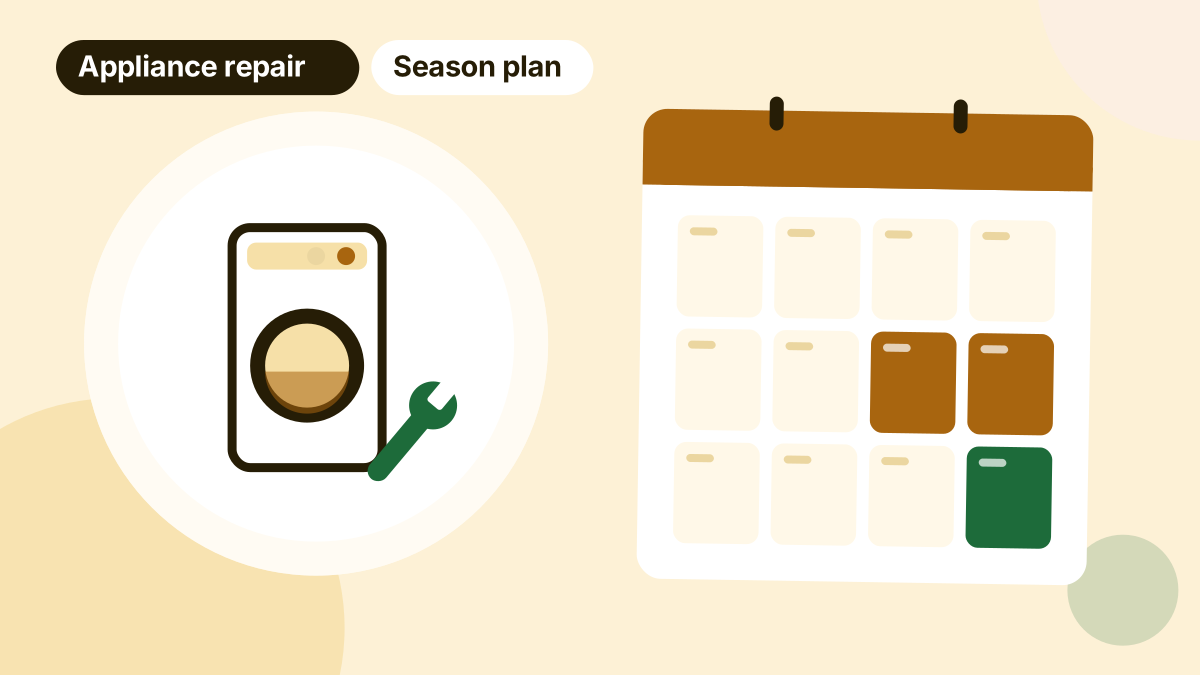
Winter residents arrive and the state fills up. Restaurants, med spas, dentistry and home services all run hot, and part-year residents schedule work they have been deferring since spring.
Spring training brings visitors across the Valley and the gem show fills Tucson. Hotel demand peaks, restaurant covers compress into a few weeks, and anything appearance-related books out.
Monsoon and extreme heat together. Dust storms, microbursts and flash flooding produce roofing, tree and water damage calls, and air conditioning shifts entirely into emergency mode.
The quietest weeks for anything tourism-facing, and the right time for maintenance plans, membership offers and the website work nobody has time for in February. Students return to Tempe, Tucson and Flagstaff in August.
The year reopens. Patios, outdoor events and exterior projects restart in the same two or three weeks, and the businesses that pre-sold in September take the calendar.
The businesses this applies to most.
Home Services
HVAC, plumbing, electrical and cleaning companies that need the phone ringing in season and a pipeline that holds out of season.
See the playbookMed Spas & Aesthetics
Consult bookings for injectables, laser and body treatments, with ads that pass platform review and follow-up that fills the calendar.
See the playbookDental Practices
New-patient growth for general, cosmetic and specialty practices, from map-pack rankings to phones that get answered.
See the playbookRemodeling & Contractors
Kitchen, bath and whole-home remodelers selling five-figure projects, where proof comes before the ask and the estimate request is the win.
See the playbookRestaurants
Restaurants and cafes competing in the map for tonight, where photos, reviews, menus and reservations decide who gets the table.
See the playbookWellness & Clinics
Chiropractic, physical therapy, salons and wellness centers that live on repeat visits and need new patients without the churn.
See the playbookNot listed? We work with most businesses that live on nearby customers. See all industries.
Things that are not optional here.
Each of these changes something concrete about how a campaign or a site is put together. Your attorney has the final say and we build to it.
The clocks do not change here
Arizona stays on Mountain Standard Time all year, with the Navajo Nation as the exception. For six months the state lines up with Pacific time and for six months with Mountain. Ad schedules, call routing, review request timing and automated follow-up all drift by an hour twice a year when a vendor sets them up assuming otherwise.
One agency licenses the trades
Plumbing, electrical, air conditioning and general contracting all run through the Registrar of Contractors rather than being split across separate boards. That makes a licence easy for a homeowner to verify and easy for a competitor to check, so the ROC number belongs in the advertising, in the profile and in the site footer, not behind a generic badge graphic.
Dental advertising is board-governed
The Arizona State Board of Dental Examiners licenses dentists in the state and governs how practices may present credentials and specialties in advertising. We write claims a practice can defend, and where a specialty term is restricted we describe what the doctor actually is instead.
Straight answers.
We are in Chandler but our ads say Phoenix. Does that matter?
More here than in most states. The Valley reads as one continuous city from the freeway, but people search by municipality and Google ranks on where the searcher is standing. If your address is in Chandler, your profile, your site and your ad copy should say Chandler, then earn Gilbert and Tempe on their own merits rather than hiding behind the metro name.
Our bookings die in July. Should we turn everything off?
It depends which side of the heat you sit on. A cooling company should be spending more in July, on answering and booking rather than on new leads. A patio restaurant or a Scottsdale med spa is usually better off cutting acquisition and putting the summer into memberships, retention and the site work nobody has time for in February.
Does Arizona skipping daylight saving really affect our marketing?
It affects anything set on a clock. Ad schedules, after-hours call routing, review requests and automated follow-up all shift by an hour twice a year if the account or the CRM was built by someone assuming the state changes with everyone else. We check it on every build because it is silent and it costs calls.
We are a contractor. Where does the licence number belong?
In the advertising, on the site and in the profile. Arizona runs plumbing, electrical, air conditioning and general contracting through a single agency, the Registrar of Contractors, which makes a licence easy for a homeowner to look up and easy for a competitor to check. A visible ROC number does more for trust here than any trust badge.
Do winter residents actually book local providers, or wait until they go home?
Both, and it varies by trade. Home services, urgent dental work and restaurants get the winter months outright. Elective and cosmetic work is a longer conversation, and the practices that win it start in November rather than in March when the person is already packing. Your own booking history answers this faster than any survey.
Is Tucson worth a separate plan from Phoenix?
Yes, if you genuinely serve it. Ranking in the Valley does nothing for you in Tucson, the competitive set is different, clicks cost less, and buyers there lean harder on reviews and local reputation. Treated as an afterthought it produces nothing; treated as its own market it is often the cheaper half of the account.
Where answer engines get local recommendations
Run the same fifteen prompts through two engines, log who is named and what is cited, and you will find the records quietly answering on your behalf.
ReadTexting that arrives: registration and consent
Why business texts get filtered before anyone sees them, how we register and capture consent properly, and the five follow-up sequences worth running.
ReadThe mid-year audit of your local presence
Half the year is gone. The profile fields, listings, photos, hours and unanswered questions we go back over in July, in the order we work through them.
ReadFind out what your radius actually looks like.
Tell us about your business and the areas you serve. We will show you who is winning the map in your radius today, what your phone does after hours, and what it would take to be the business that gets the call.
Form not loading? Email hello@beyaoshy.com and we will reply within one business day.